
Think of a Security Operations Center (SOC) as the central command hub for your company's cybersecurity defense. It's where a dedicated team of experts, armed with sophisticated technology and well-defined processes, stands guard 24/7. This isn't just an IT department—it's more like a digital emergency room or an air traffic control tower for your data, constantly watching for threats.
The entire mission boils down to one critical, actionable goal: detect, analyze, and respond to cybersecurity incidents before they can cause real damage.
Understanding the Digital Fortress

A SOC fundamentally changes how a business approaches cybersecurity, moving it from a passive, reactive stance to an active, vigilant one. Instead of just cleaning up a mess after an attack, the SOC team is always hunting for signs of trouble across the organization’s entire digital footprint—from networks and servers to applications and individual devices. For a great primer on its foundational purpose, check out this overview of What Is a Security Operations Center.
This constant watchfulness is non-negotiable today. With the average cost of a data breach soaring to $4.45 million, proactive defense isn't a luxury; it’s a business survival strategy. A SOC acts as the central nervous system for your entire security posture, providing the operational muscle to turn policies into protection.
The Core Mission of a SOC
The main job of any SOC is to shrink the impact of a security incident down to nothing, if possible. This mission is built on several key functions that work together to create a powerful defensive shield, ensuring threats are not just spotted but handled quickly and decisively.
To give you a clearer picture, here’s a rundown of what a modern SOC does to protect your business day-to-day.
Key Functions of a Modern SOC
| Function | Actionable Insight |
|---|---|
| Continuous Monitoring | Actively watching all digital assets—from employee laptops to cloud servers—to spot unusual or malicious activity in real time. |
| Threat Detection & Analysis | Using advanced tools to filter through millions of data points, identify genuine threats, and understand their potential business impact. |
| Incident Response & Remediation | Taking immediate, predefined actions to contain a threat, remove it from the system, and restore normal operations as quickly as possible. |
| Proactive Threat Hunting | Actively searching for hidden threats that may have bypassed automated defenses, rather than just waiting for an alert to trigger. |
These responsibilities ensure that the SOC team is always on the front foot, ready to tackle whatever comes next.
A modern SOC’s purpose is twofold: dealing with security problems in real time and continually seeking ways to improve an organization’s security posture. It's about both immediate response and long-term resilience.
Why This Matters for Your Business
In high-stakes industries, the role of a SOC becomes even clearer. For a healthcare provider, it’s the team that executes the plan to protect sensitive patient records from a crippling ransomware attack. In the financial sector, it’s the group that actively safeguards client accounts and prevents fraudulent transactions from ever happening.
Ultimately, a SOC provides the structure, expertise, and technology needed to protect a company's most valuable assets. You can get a better sense of the day-to-day work by exploring what goes on inside cybersecurity operations. This operational hub is what allows businesses to operate with confidence in an increasingly dangerous digital world.
Where Did the Modern SOC Come From?
To really grasp what a modern Security Operations Center does, you have to look at where it came from. The SOC wasn't just invented one day; it was forged in the fire of decades of escalating digital attacks. Its story is really the story of cybersecurity itself—a constant tug-of-war between attackers and defenders.
The earliest whispers of a SOC go all the way back to the 1980s, right when the first computer viruses appeared. Back then, security was a brute-force, manual job. Teams of specialists would spend their days hunched over, painstakingly digging through endless log files and network traffic by hand, just hoping to spot something out of place. You can learn more about how these early efforts paved the way for modern SOCs and their slow march toward automation.
It was a slow, reactive process, but for a while, it worked. The digital world was smaller, and the threats were far simpler. That wasn't going to last.
The Turning Point for Security Monitoring
Everything changed in the early 2000s. The internet exploded, and a whole new breed of sophisticated threats came with it—advanced malware, worms, and coordinated attacks that could cripple a network in minutes. The sheer flood of data and the speed of these new attacks made manual monitoring completely useless.
Security teams were drowning. Buried under a mountain of alerts and log entries, they couldn't tell a real threat from all the background noise. It was obvious a new approach was needed, one that could actually keep up.
The core problem was painfully simple: human analysts just couldn't move at the speed of machine-led attacks. The entire industry had to innovate, or it would be completely steamrolled by an increasingly hostile digital world.
This pressure cooker environment is what gave birth to the foundational technologies that define every modern SOC today.
The Birth of Foundational SOC Technologies
To fight back against this rising tide, a couple of key technologies emerged that would become the cornerstones of security operations. These tools were built to automate the heavy lifting of detection, freeing up human analysts to do what they do best: analyze and respond.
Intrusion Detection Systems (IDS): These were some of the first automated security guards. An IDS would sit on the network and watch traffic for known malicious patterns or signatures, automatically flagging anything suspicious. Think of it as a digital tripwire, alerting teams the moment an intruder stepped over the line.
Security Information and Event Management (SIEM): SIEM platforms were a massive leap forward. For the first time, you could pull log data from everywhere—firewalls, servers, applications—into one single place. This gave security teams a unified view of their entire environment, making it infinitely easier to connect the dots and spot complex attack patterns that were previously invisible.
These tools weren't just nice-to-haves; they were essential weapons in a rapidly evolving war. They gave security teams the visibility and control they had lost, setting the stage for the powerful, proactive Security Operations Centers that protect businesses today. Without them, modern cyber defense simply wouldn't exist.
The Three Pillars of an Effective SOC
A truly effective Security Operations Center isn't just a room full of screens and blinking lights. It's a living, breathing defense system built on three interconnected pillars that work in harmony: the right people, well-defined processes, and powerful technology.
When one of these pillars is weak, the entire structure is at risk.
Think of it like an elite fire department. You need skilled firefighters (people), a clear plan for every type of emergency (processes), and the right equipment like trucks and hoses (technology). Without all three working together, you can't effectively fight the fire. A modern SOC functions on the same principle to combat digital threats.
The People: The Human Element of Cyber Defense
Technology is crucial, but it’s the human experts who interpret the data, make critical decisions, and hunt for threats that automated tools might miss. These individuals are the heart of the SOC, each with a specialized role that contributes to the overall defense.
The SOC team is a tiered system designed for efficiency, ensuring that every alert gets the right level of attention without overwhelming senior experts.
Here's a look at the key roles that make up a typical SOC team and what each person brings to the table.
| Role | Primary Responsibility |
|---|---|
| Tier 1 Analyst (The First Responder) | Sits on the front lines, triaging a constant stream of alerts, filtering out false positives, and escalating genuine threats. |
| Tier 2 Analyst (The Investigator) | Conducts deep-dive investigations into serious incidents flagged by Tier 1, determining the scope and root cause of an attack. |
| Tier 3 Analyst (The Threat Hunter) | Proactively hunts for advanced, hidden threats that have bypassed automated defenses, using deep expertise to uncover sophisticated campaigns. |
| SOC Manager (The Commander) | Oversees the entire operation, coordinates the team, manages resources, and acts as the bridge between the SOC and the rest of the business. |
Without this skilled team, even the most advanced technology is just generating noise. It’s their expertise that turns raw data into a coordinated defense.
The Processes: The Playbook for Incident Response
Even the most talented team can't function effectively without a clear plan of action. Processes are the standardized workflows and procedures that guide the SOC's response to any security event, ensuring every incident is handled consistently, efficiently, and thoroughly.
This structured approach is vital for maintaining the importance of continuous monitoring for cybersecurity.
This isn't a new concept, but it has evolved dramatically. Early SOCs relied heavily on manual documentation and checklists. Today, automation is baked into the process from the start.
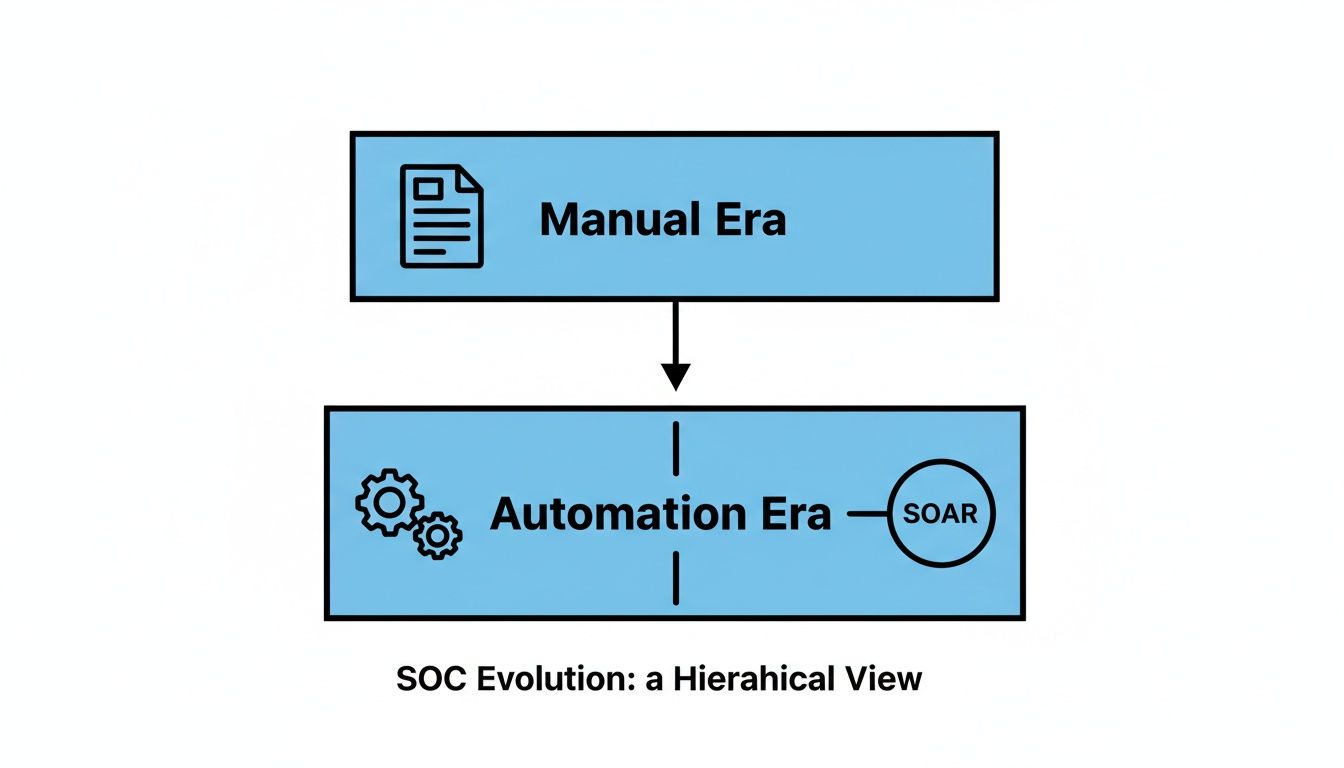
As the visualization shows, this shift isn't just an add-on; it's a fundamental change that allows modern teams to keep up with the sheer volume of today's threats.
A well-defined incident response plan is an actionable playbook that typically follows these key stages:
- Detection: Identifying a potential security event from alerts.
- Triage: Quickly assessing the alert to determine its severity and business impact.
- Investigation: Analyzing all data to confirm the threat and understand its behavior.
- Containment: Isolating affected systems to stop the threat from spreading.
- Eradication: Removing the threat completely from all systems.
- Recovery: Restoring systems to normal operation and confirming they are secure.
- Post-Incident Review: Analyzing the incident to identify lessons learned and improve future responses.
The Technology: The SOC Toolkit
The final pillar is the technology stack—the arsenal of tools that provides visibility, automates tasks, and empowers analysts to do their jobs. The period between 2007 and 2013 is often seen as a golden age for SOC evolution, as this was when foundational tools like SIEM platforms became mainstream, giving teams unprecedented control.
At its core, SOC technology is about turning a massive ocean of raw data into a handful of actionable insights. Without the right tools, analysts would be completely overwhelmed and unable to spot real threats.
A modern SOC's toolkit is built around a few core technologies:
Security Information and Event Management (SIEM): This is the central brain of the SOC. A SIEM collects, aggregates, and correlates log data from across the entire organization, providing a single pane of glass for monitoring and threat detection.
Endpoint Detection and Response (EDR): EDR tools are installed on individual devices like laptops and servers. They monitor for suspicious activity at the endpoint level, allowing analysts to detect and respond to threats that might otherwise go unnoticed.
Security Orchestration, Automation, and Response (SOAR): SOAR platforms help automate repetitive, manual tasks. They can automatically enrich alerts with threat intelligence or even take predefined actions, like blocking a malicious IP address, freeing up analysts to focus on more complex work.
Deciding to Build or Outsource Your SOC
One of the biggest strategic questions you'll face is whether to build a Security Operations Center from the ground up or bring in a managed provider. This isn't just about a line item on a budget; it's a decision that will define your security capabilities, day-to-day operations, and how well you can weather an attack.
Each path has its own set of pros and cons. The right choice really comes down to your company’s resources, risk tolerance, and the expertise you already have on your team.
Evaluating the In-House SOC Model
Building your own SOC gives you the ultimate control. You get to hand-pick your team, choose every piece of technology, and design every process to fit your business like a glove. This level of ownership means you can deeply integrate security into your company culture and operations.
But that control comes at a steep price. The financial investment for enterprise-grade tools, infrastructure, and a secure facility can easily climb into the millions.
Beyond the initial setup, the ongoing operational costs are massive. The single biggest hurdle is almost always talent. The cybersecurity skills gap is real, and finding—then keeping—elite analysts, engineers, and threat hunters is incredibly competitive and expensive. On top of that, providing true 24/7/365 coverage means staffing multiple shifts, which sends personnel costs and management headaches through the roof.
Actionable Takeaway: Building an in-house SOC is like building a custom house. You get exactly what you want, but you're also responsible for every nail, wire, and leaky faucet—a commitment that requires deep pockets and specialized expertise.
Exploring the Managed SOC Option
Outsourcing to a managed SOC provider, often called a Managed Security Service Provider (MSSP), offers a powerful alternative. This model gives you immediate access to a mature, fully-staffed security operation without the crippling upfront capital investment. When weighing your options, understanding the full scope of MSSP security services is a crucial step.
The main benefits are obvious: it's more cost-effective and you get instant expertise. For a predictable monthly fee, you get the horsepower of an enterprise-grade tech stack and a team of seasoned pros who have seen it all. This approach lets you sidestep the nightmare of recruiting and retaining top security talent.
Managed providers also offer incredible scalability. As your business grows, your security coverage expands right alongside it, and you don't have to worry about hiring more people or buying more hardware. This kind of flexibility is a game-changer for growing companies. The partnership model often works similarly to IT support, and it can be helpful to compare fully-managed vs. co-managed IT support to understand the dynamic.
Making the Right Strategic Choice
The build-or-buy decision isn't just technical—it's a core business strategy question. To figure out the right path, you need to take a hard, honest look at what your organization can realistically handle.
Use these questions as a starting point to guide your decision:
- Budgetary Reality: Do we have the significant, multi-year capital to build and run an in-house SOC? This includes salaries for at least 8-12 full-time employees needed for 24/7 coverage.
- Internal Expertise: Do we already have the cybersecurity talent on staff to manage a complex security operation, or would we be starting from zero?
- Risk Tolerance: What's the business impact if our security response is slow? Can we afford the time it will take to build and mature our own team, or do we need expert protection right now?
- Regulatory Needs: Are our compliance requirements (like HIPAA, PCI-DSS, or FINRA) so specific that only an in-house team can manage them, or can a managed provider with experience in our industry handle them effectively?
Answering these questions will bring clarity and help you choose the SOC model that doesn't just protect your assets but also aligns with your business goals, making sure your security investment truly pays off.
Your Action Plan for Implementing SOC Capabilities

You now understand the "what" and "why" behind a SOC. It's time to create a practical plan to make it happen. Shifting from theory to practice requires a clear strategy, because a SOC isn’t just another piece of software you buy—it's a fundamental business function that must be built around your specific risks, resources, and goals.
This roadmap is designed to help you take decisive action. The objective is to transform your security from a reactive, check-the-box exercise into a proactive asset that protects you today and scales with you tomorrow.
Step 1: Identify Your Critical Vulnerabilities
Before you can build a stronger defense, you need an honest look at your current one. Where are the cracks? Start by identifying your "crown jewels"—the data, systems, and applications that your business absolutely cannot function without.
Next, conduct a thorough risk assessment to pinpoint where your current security measures fall short. Are you blind to what’s happening on employee laptops? Do you have any visibility into your cloud environments? This step gives you the "why" behind every decision you'll make, ensuring your SOC investment is tied directly to mitigating actual business risk.
Actionable Takeaway: An effective security strategy isn't about eliminating all risk, but about understanding and managing it. Knowing your weaknesses is the first step toward building a truly resilient organization.
Step 2: Set Clear Security and Compliance Goals
With a clear picture of your risks, you can define what success actually looks like. Your goals need to be specific and measurable. Ditch vague statements like "improve security" and aim for a concrete, actionable target like "achieve 24/7/365 threat detection and response capabilities."
This is also the time to get serious about compliance. Whether you're dealing with HIPAA, PCI-DSS, or FINRA, your SOC's technology and procedures must be built to satisfy those specific mandates. This ensures your security investment pulls double duty by protecting your business and satisfying your legal obligations.
Step 3: Arm Yourself with the Right Questions
Finally, whether you're building a SOC in-house or evaluating a managed service, you need to know what to ask. If you're talking to a potential managed SOC provider, your questions should be sharp and demanding.
Here are the key questions that will cut through the sales pitch and give you actionable answers:
- Response Times: What are your guaranteed Service Level Agreements (SLAs) for detecting a threat, responding to it, and containing the damage?
- Industry Expertise: Can you provide case studies or references from other companies in our industry, like healthcare or finance?
- Technology Stack: What specific SIEM, EDR, and SOAR platforms do you use? How will they integrate with the tools we already own?
- Reporting and Visibility: What kind of reports will we get? How much direct visibility will we have into security incidents and the actions your analysts are taking?
These questions will help you separate the true security partners from the vendors just trying to sell you a product.
Common Questions About Security Operations Centers
When you start digging into what a Security Operations Center really is, a few practical questions always come up. Before you can decide if a SOC is right for your business, you need clear, straightforward answers.
How Much Does a SOC Cost?
The cost of a Security Operations Center swings wildly depending on one big decision: do you build it yourself or hire a service?
- In-House SOC: The upfront investment here is massive. We're talking millions for enterprise-grade tools, a secure facility, and the initial setup. But the ongoing costs are even steeper, driven by the need for 24/7 staffing (that’s 8-12 full-time analysts), competitive salaries, and constant training to keep their skills sharp.
- Managed SOC (SOC-as-a-Service): This model flips a huge capital expense into a predictable monthly operational cost. For one flat fee, you get an entire team of experts and a fully-equipped SOC, making it a much more realistic option for most businesses.
Actionable Takeaway: For most small and mid-sized organizations, a managed SOC delivers a higher level of security maturity for a fraction of what an in-house build would cost. It completely sidesteps the massive financial hit and the headache of finding and retaining top-tier talent.
What's the Difference Between a SOC and a NOC?
While both are command centers, a Security Operations Center (SOC) and a Network Operations Center (NOC) have completely different jobs. Think of it this way: a NOC is the mechanic keeping the engine running smoothly, while a SOC is the security team protecting the entire convoy from attack.
A NOC’s main goal is uptime and performance. Its team watches over network health, bandwidth, and server availability to make sure nothing goes down or slows to a crawl. In contrast, a SOC’s sole focus is security. It hunts for cyber threats, malicious activity, and potential breaches to defend the organization from attackers.
How Quickly Does a SOC Respond to Incidents?
In cybersecurity, speed is everything. A top-tier SOC operates on strict timelines spelled out in Service Level Agreements (SLAs). These are contractual guarantees that dictate exactly how fast the team will act at every stage of an incident.
You'll want to look for specific, measurable SLAs for key metrics like:
- Time to Detect: How quickly a potential threat is first spotted.
- Time to Investigate: How fast an analyst starts digging into the alert.
- Time to Contain: How long it takes to wall off the threat and stop its spread.
An effective SOC provides 24/7/365 monitoring because attackers don't work 9-to-5. This constant watch ensures that a threat found at 3 AM on a Sunday gets the same urgent response as one discovered during business hours, drastically limiting the potential damage.
Ready to secure your business with a proactive, 24/7 defense? CitySource Solutions provides a fully managed SOC to protect your critical assets and ensure compliance without the cost and complexity of building your own. Learn more at https://citysourcesolutions.com.