
Think of managed IT services as your nonprofit's dedicated, on-demand technology team, available for a predictable monthly fee. This approach gives you access to high-level IT support and cybersecurity that was once only available to large corporations. Your immediate action is to shift your mindset: view IT not as an expense, but as a strategic tool to achieve your mission. This partnership is designed to make professional IT management both affordable and effective, freeing you to focus on what matters most.
Why Your Nonprofit Needs a New Approach to IT
For most nonprofits, managing technology is a constant uphill battle against tight budgets, a lack of in-house technical experts, and the same cybersecurity risks faced by for-profit businesses. This leaves your team in a reactive, "break-fix" mode, just trying to keep the lights on rather than advancing your cause.
This reactive approach is unsustainable. It's time to stop fixing problems as they pop up and move to a model that prevents them from happening in the first place.
The Shared Expert Department Model: Your First Actionable Step
Your first step is to reframe how you see IT support. Picture a managed IT services provider (MSP) as your organization's shared, expert IT department. This model makes top-tier support accessible because you're pooling resources with other organizations. For a predictable monthly fee, you get an entire team of specialists—from helpdesk technicians to cybersecurity analysts—for less than the cost of a single, full-time IT hire.
This partnership allows you to offload complex tech challenges. Instead of your program director troubleshooting a server or your marketing coordinator wrestling with software, these tasks go to dedicated professionals.
Actionable Insight: Hand over day-to-day technical management to an MSP. This frees your staff to pour their full energy and talent into driving your nonprofit's mission forward.
This isn't just about fixing computers; it's about building a reliable and secure technology foundation. This includes protecting donor data from hidden cyber threats antivirus software often misses and creating a technology roadmap for the next five years. Adopting managed IT services for nonprofits is a proactive step toward operational stability and long-term growth.
What an IT Partner Actually Does for Your Organization
Let's cut through the jargon. A managed IT partner acts as an extension of your team, ensuring your technology actively fuels your mission. They handle the complexities so your staff can stay focused on running programs, engaging donors, and serving the community.
This is a world away from the "break-fix" model where you only call for help when a server crashes during a fundraising campaign. A true partner works to prevent that crisis. For example, their proactive 24/7 monitoring acts like a security guard who never sleeps, spotting trouble before it can cause costly downtime or a data breach.
The core IT challenges for nonprofits—tight budgets, an internal expertise gap, and rising security risks—are exactly what a managed services model is built to solve.
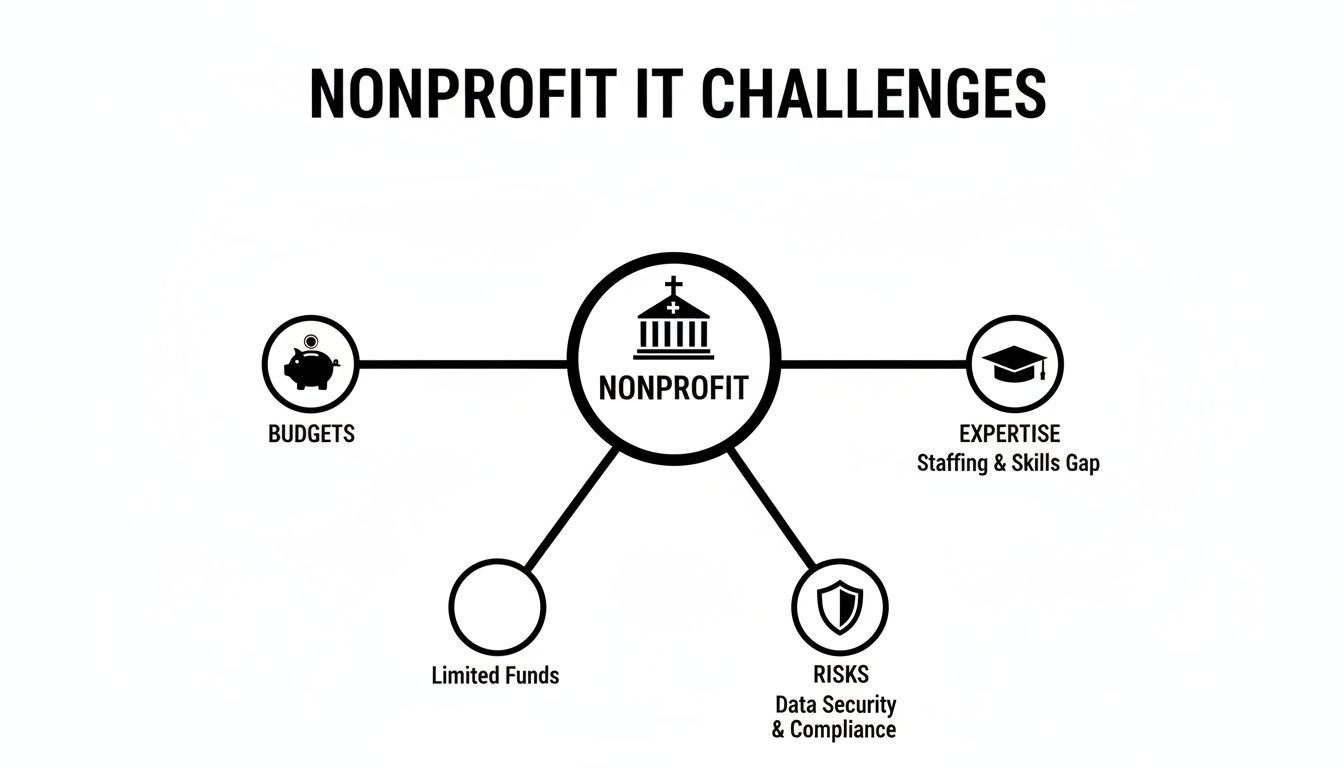
This constant balancing act is where many organizations get stuck.
To make this tangible, here’s an actionable look at the core services an MSP provides and how each one directly translates into mission impact.
Core Managed IT Services and Their Mission Impact
| Service Component | Your Actionable Benefit | How It Directly Supports Your Mission |
|---|---|---|
| Dedicated IT Helpdesk | Empower your team with fast, expert answers for daily tech issues like email problems or file access. | Eliminate frustrating tech delays to keep staff productive and programs running smoothly. |
| Proactive Cybersecurity | Implement a multi-layered defense, from 24/7 threat monitoring to security awareness training for your staff. | Protect sensitive donor data, maintain trust, and prevent breaches that could shut you down. |
| Cloud & Infrastructure Management | Securely manage essential tools like Microsoft 365 or your fundraising platforms. | Enable your team to collaborate securely from anywhere—the office, home, or in the field. |
| Strategic IT Guidance | Get a clear technology roadmap, practical budget planning, and expert advice for future decisions. | Ensure your technology investments align with long-term goals and prevent expensive surprises. |
These services work together to create a stable, secure, and efficient technology foundation, allowing your organization to focus its resources where they matter most.
Actionable Insight: Your goal in finding an IT partner is simple: turn technology from a source of frustration into a reliable asset that multiplies your mission's impact.
What If We Already Have an IT Person? Enter Co-Managed IT
If you have a dedicated—and often overworked—"IT person" on staff, a co-managed IT model is your best course of action. It doesn't replace them; it empowers them by providing the backup and specialized tools they need.
Your on-site staff can focus on high-touch user support and mission-specific applications. Meanwhile, the MSP handles the heavy lifting in the background, like managing complex servers, running a 24/7 security operations center (SOC), or implementing sophisticated data backup and disaster recovery plans. This partnership fills expertise gaps without adding headcount.
The Real Financial Case for Outsourcing Your IT
Every nonprofit leader scrutinizes the bottom line. Any dollar spent on overhead feels like a dollar pulled from the mission. But what if you could flip that script? Partnering with a managed services provider (MSP) delivers a powerful and often surprising return on your investment.

The clearest win is predictable budgeting. Forget chaotic, reactive spending on emergency fixes. An MSP moves you to a flat-rate monthly fee that covers everything from daily helpdesk tickets to proactive cybersecurity. This stability is a game-changer for financial planning. A single server failure won't suddenly devour thousands of dollars earmarked for a community program.
Shifting from Overhead to Mission Investment
Let's compare the costs. Hiring one full-time IT professional is a massive expense beyond their salary when you factor in benefits, taxes, and ongoing training. With an MSP, your monthly fee gives you access to an entire team of certified specialists—network engineers, cybersecurity experts, cloud architects—for a fraction of that cost.
This isn't just about saving money; it's about strategic reallocation. Recent research shows U.S. nonprofits are projected to boost technology spending to USD 78,790.0 million by 2030. Organizations that have already switched to managed services report cutting IT costs by 25-45% while boosting operational efficiency by 45-65%.
Actionable Insight: By outsourcing IT, you are taking funds that would have been locked into administrative overhead and pushing them back into your core programs, where they can make a real difference.
This is the core financial case for managed IT services for nonprofits.
Uncovering the Hidden ROI
Beyond direct cost savings, there are significant "hidden" returns. These benefits might not be a line item on the budget, but their impact is undeniable.
Here are the financial gains to look for:
- Boosted Staff Productivity: When your team isn't battling slow computers or glitchy software, they focus 100% on their work. An MSP resolves problems fast, giving you back precious staff hours.
- Minimized Downtime: Unplanned downtime halts fundraising and disrupts program delivery. Proactive monitoring prevents these outages, protecting your revenue and reputation.
- Scalable Operations: As your nonprofit grows, an MSP lets you scale IT support up or down as needed, without the huge capital investment in new hardware or staff.
These factors add up to a substantial financial benefit. Learn more about how you can achieve these results with all-inclusive managed IT benefits designed for your nonprofit's growth.
Protecting Donor Data and Ensuring Compliance
For any nonprofit, trust is everything. A data breach shatters that trust, potentially crippling fundraising and damaging your reputation for years.

Unfortunately, nonprofits are prime targets. Bad actors know you manage sensitive records without corporate-level defenses. The threat is existential: in 2023, 72.7% of organizations worldwide were hit with ransomware. More sobering, 60% of small and medium-sized entities—including most nonprofits—close within six months of a cyber incident. You can get more insights on how MSPs help nonprofits survive these threats.
Partnering with a managed IT provider is a critical survival strategy.
Building a Modern Security Shield
An MSP delivers multi-layered defense that goes beyond simple antivirus software. It's about building a comprehensive security posture that neutralizes risks before they cause harm.
A core component is a 24/7 Security Operations Center (SOC)—a dedicated command center staffed by experts watching over your network. They are your digital night watch, stopping threats at any hour.
This proactive monitoring is combined with other critical security layers:
- Advanced Endpoint Protection: Secure every device connecting to your network—laptops, desktops, and phones—protecting data wherever your team works.
- Zero Trust Security Models: This modern approach works on the principle: "never trust, always verify." It demands strict identity verification for every user and device, drastically reducing unauthorized access.
Actionable Insight: Implement enterprise-grade security through an MSP. This levels the playing field, giving your nonprofit protection that was once out of reach.
Demystifying Compliance Requirements
Beyond preventing attacks, an IT partner helps you navigate the complex web of data privacy regulations. Whether you must comply with HIPAA or meet PCI-DSS standards for donations, staying compliant is non-negotiable.
An MSP specializing in managed IT services for nonprofits understands these requirements. They implement the necessary technical controls, maintain audit trails, and ensure your data handling meets legal standards. This frees your team from the overwhelming burden of interpreting dense regulatory language.
How to Choose the Right IT Partner for Your Mission
Picking a managed services provider is a strategic move. You're not just buying a service; you're choosing a partner who will become a core part of achieving your mission. The right team understands the unique challenges nonprofits face and aligns their technology advice with your goals.
A provider that only works with corporate clients won't understand the nuances of donor management software or the need to stretch every dollar. You need a team that speaks your language. The process requires a thoughtful approach: focus on finding a partner who acts as a true extension of your team.
Key Qualities of a Mission-Aligned IT Partner
Before you start asking questions, know what to look for. By 2023, MSPs became essential for nonprofits dealing with IT talent shortages. This is mainly because many organizations don't have full-time IT staff, a gap MSPs fill with certified teams ready to provide 24/7 support. You can read more about these nonprofit technology trends and predictions.
Your ideal partner must demonstrate these qualities:
- Proven Nonprofit Experience: They need a track record with organizations like yours. Ask for case studies or references from other nonprofits.
- A Security-First Mindset: Cybersecurity must be integrated into everything they do, not an optional add-on.
- Transparent and Predictable Pricing: Demand a clear, all-inclusive proposal without hidden fees. Your budget should be simple and accurate.
- Strategic Guidance, Not Just Fixes: A great partner meets with you regularly to review your technology roadmap and ensure your IT investments are built for the long term.
Actionable Insight: Choose a partner who invests in your mission's success as much as you do. Their guidance should always be measured against its potential to advance your cause.
Your Vendor Evaluation Checklist: Questions to Ask
Once you have a shortlist, it's time to dig in. Use these questions to get a real feel for their capabilities and cultural fit. This is also the time to determine if a fully managed vs. a co-managed IT support model is right for you.
- Response and Resolution: What are your guaranteed response times in your Service Level Agreement (SLA)? How do you prioritize urgent issues that could halt our programs?
- Team Expertise: Are your engineers U.S.-based? What certifications do they hold, and do they receive ongoing cybersecurity training?
- Onboarding Process: Walk me through your onboarding process. How do you ensure minimal disruption for our staff during the transition?
- Security and Compliance: Can you detail your security stack? How do you help nonprofits stay compliant with regulations like HIPAA or PCI-DSS?
- Strategic Partnership: How often will we meet to discuss strategy and long-term planning? Provide an example of how you’ve helped another nonprofit use technology to advance its mission.
Of course. Here is the rewritten section, designed to match the expert, human-written style of the provided examples.
Common Questions About Managed IT for Nonprofits
Switching your technology approach always raises questions. Most nonprofit leaders share concerns about cost, control, and data security. Getting straight answers is the final step before you can confidently bring in a managed services partner.
Let's tackle the most common questions we hear.
Are Managed IT Services Genuinely Affordable for a Small Nonprofit?
Yes, and it’s often more affordable than the alternatives. Hiring a single, full-time IT person comes with a salary, benefits, vacation, and training costs. A managed service trades that for a predictable, flat monthly fee.
This model simplifies budgeting by eliminating surprise break-fix costs. But the real value is in preventing expensive downtime and giving your team back the hours lost to tech frustrations.
We Have an IT Person Already. Can an MSP Still Help Us?
Absolutely. This is a perfect scenario for a co-managed IT partnership. Your internal staffer knows your mission-critical applications and team needs better than anyone. They can remain the on-the-ground expert.
Meanwhile, the MSP acts as their powerful backup, bringing heavy-duty tools like 24/7 network monitoring, advanced cybersecurity defenses, and specialized expertise for bigger projects like a cloud migration. It’s a partnership that enhances what you already have.
Actionable Insight: A reputable MSP stakes its business on security. A trustworthy provider will be fully transparent and can deliver an enterprise-grade security posture that most nonprofits could never achieve on their own.
How Can We Trust a Third Party with Our Sensitive Donor Data?
This is the most critical question to ask. When vetting a potential partner, demand a full walkthrough of their security stack.
Ask them: What does your 24/7 Security Operations Center (SOC) do? How is our data encrypted at rest and in transit? Do you hold compliance certifications like HIPAA or PCI-DSS? Protecting your data is their number one job, and they must prove they are up to the task.
Ready to build a secure and reliable technology foundation for your mission? CitySource Solutions provides expert managed IT services designed to help nonprofits thrive. Learn how we can support your organization by visiting us at https://citysourcesolutions.com.
Article created using Outrank