
In today's complex IT landscape, merely reacting to outages is a recipe for downtime, data loss, and regulatory penalties. Proactive IT infrastructure monitoring has evolved from a simple health check into a strategic business function, essential for ensuring security, compliance, and operational resilience. For organizations in highly regulated industries like healthcare, finance, legal, and manufacturing, the stakes are even higher. Effective monitoring is not just about keeping the lights on; it's about safeguarding sensitive data, meeting stringent compliance mandates (like HIPAA, PCI-DSS, and FINRA), and aligning technology directly with business outcomes.
This guide moves beyond generic advice to provide a detailed roundup of 10 actionable IT infrastructure monitoring best practices. Each practice is designed to be implemented today, offering specific steps, real-world examples, and guidance on how a managed services provider can operationalize these strategies to transform your IT from a cost center into a reliable platform for growth.
We will cover a comprehensive range of topics critical for modern operations, from establishing a centralized monitoring platform and implementing proactive alerting to deploying managed SIEM and monitoring cloud environments. You will learn how to maintain a complete asset inventory, perform continuous vulnerability scanning, and map service dependencies to create effective runbooks. The goal is to provide a clear, step-by-step framework to help you gain complete visibility and control over your environment. By adopting these proven strategies, you can shift your team's focus from firefighting to strategic improvement, ensuring your infrastructure is secure, performant, and fully compliant with industry standards.
1. Implement a Centralized Monitoring Platform
Fragmented monitoring tools create dangerous blind spots, especially in regulated industries like healthcare, finance, and law. Implementing a centralized monitoring platform, often called a "single pane of glass," is one of the most critical IT infrastructure monitoring best practices because it unifies data from all sources. This approach aggregates logs, metrics, and traces from on-premises servers, cloud services like Microsoft 365 and Azure, network devices, and endpoints into one coherent dashboard. This unified view enables IT teams to correlate events across disparate systems, drastically reducing Mean Time to Detection (MTTD) and Mean Time to Resolution (MTTR).
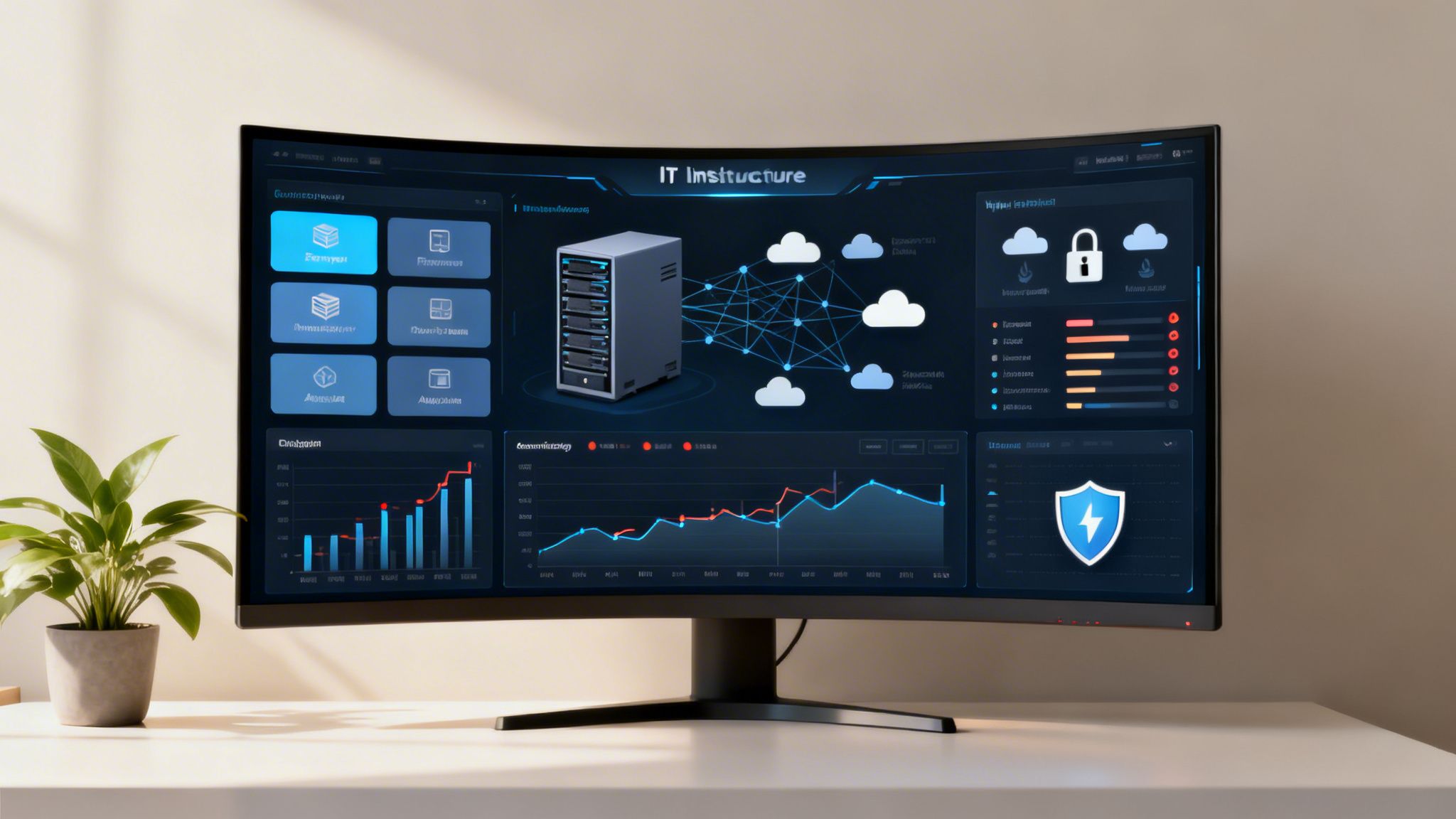
For organizations handling sensitive data, this centralized visibility is non-negotiable. A healthcare system can use a platform like Datadog to ensure all systems handling Protected Health Information (PHI) adhere to HIPAA technical safeguards. Similarly, a financial services firm can leverage Splunk to provide auditors with real-time proof of PCI-DSS compliance, consolidating access logs and network traffic into a single, searchable repository.
Actionable Implementation Strategy
To successfully adopt a centralized platform, start with foundational infrastructure before layering on more complex application monitoring.
- Phase 1: Ingest Core Infrastructure Data. Begin by integrating servers (Windows/Linux), network switches, and firewalls. Establish baseline performance metrics for CPU usage, memory, and network latency.
- Create Role-Based Dashboards. Customize views for different teams. Build a dashboard for a hospital's clinical informatics team that shows EMR application uptime, while the IT operations team dashboard focuses on underlying server health.
- Activate AI-Driven Anomaly Detection. Modern platforms use anomaly detection to automatically identify unusual patterns that might indicate a security breach or an impending failure. Enable this feature to shift from reactive to proactive management.
- Establish a Weekly Alert Review Cadence. Hold mandatory weekly meetings to analyze alerts, refine thresholds, and eliminate "alert fatigue." Your goal is to ensure the team only responds to meaningful incidents.
Key Insight: A centralized platform transforms monitoring from a collection of isolated data points into a strategic, interconnected intelligence source. This is particularly vital for organizations like legal firms, where continuous monitoring is essential for protecting client-privileged information. For more information, you can learn about fortifying legal firms with continuous IT infrastructure monitoring.
How a Managed Provider Helps: A partner like CitySource Solutions can accelerate this implementation by deploying and configuring a platform like Azure Monitor or Datadog tailored to your industry's compliance needs (HIPAA, PCI, FINRA). They manage the initial setup, create customized dashboards, and fine-tune alerting rules, freeing your internal team to focus on strategic initiatives rather than tool management.
2. Establish Proactive Alerting and Threshold Management
Reactive monitoring, where teams respond only after a system fails, is a recipe for disaster in high-stakes environments. Establishing proactive alerting and intelligent threshold management is one of the most vital IT infrastructure monitoring best practices because it shifts the focus from fixing failures to preventing them. This strategy involves setting alert rules based on historical baselines, predictive analytics, and business context, allowing teams to intervene before end-users are impacted. This preemptive approach is non-negotiable for organizations where even minor downtime has severe consequences.
For a manufacturing firm, this could mean an alert on an OT network anomaly that precedes a critical equipment shutdown, saving thousands in lost production. In a nonprofit, it might be an alert for cloud infrastructure costs trending to exceed the monthly budget, preventing financial overruns. Similarly, a legal firm's practice management software can alert when email archival tasks fall behind, ensuring continuous compliance with e-discovery requirements and preventing potential sanctions.
Actionable Implementation Strategy
To build an effective proactive alerting system, you must move beyond simple, static thresholds and embrace a more dynamic and context-aware approach.
- Phase 1: Collect Performance Baselines. Before setting any alerts, collect performance data for at least two to four weeks. Use this data to create a reliable baseline of what "normal" looks like for your specific environment, including its peaks and valleys.
- Implement Tiered, Context-Aware Thresholds. Create different alert profiles for business hours versus nights and weekends. Use percentile-based triggers (e.g., alert when latency exceeds the 90th percentile) instead of fixed numbers to reduce false positives from temporary spikes.
- Define and Document Escalation Policies. Map out a multi-stage escalation path: a low-priority warning for an initial threshold breach, a high-priority alert for a more serious condition, and a critical-level page-out for imminent failure. Route alerts directly to the responsible team, such as database alerts to DBAs.
- Schedule Monthly Alert Tuning Sessions. Hold mandatory monthly reviews to analyze alert trends, adjust thresholds that are too "noisy" or too quiet, and confirm every alert is actionable. This continuous refinement cycle is key to maintaining a high-fidelity alerting system.
Key Insight: Proactive alerting transforms your monitoring system from a passive rearview mirror into a predictive, forward-looking tool. It empowers teams to protect business outcomes, whether that's patient care in a hospital, order processing for a financial firm, or production uptime in a factory.
How a Managed Provider Helps: An MSP like CitySource Solutions can operationalize this practice by configuring advanced alerting tools like PagerDuty or Azure Monitor. They analyze your historical data to set intelligent baselines, build multi-tiered escalation policies tailored to your team's structure, and manage the ongoing process of tuning and refining thresholds to eliminate alert fatigue and ensure every notification is meaningful.
3. Monitor Endpoint Security and EDR Implementation
Traditional antivirus software is no longer sufficient to protect against modern cyberattacks, especially for organizations handling sensitive data. Deploying an Endpoint Detection and Response (EDR) solution is a core component of modern IT infrastructure monitoring best practices because it provides deep, real-time visibility into all client devices. EDR platforms monitor laptops, servers, and mobile devices for malicious behavior, unauthorized access, and policy violations by tracking process execution, file system changes, and network connections. This behavioral analysis allows them to detect advanced threats that signature-based tools consistently miss.
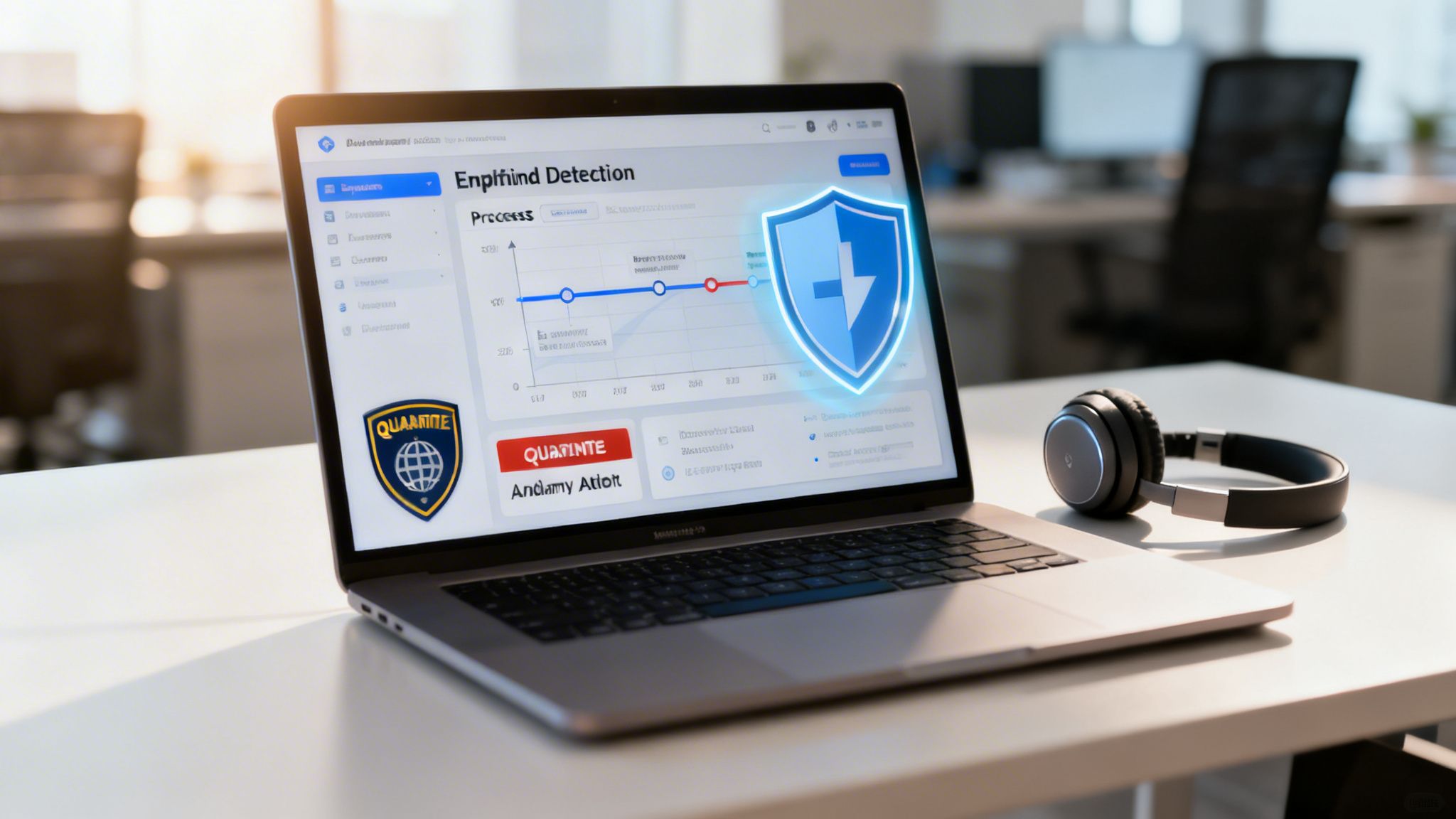
For a law firm, EDR like Microsoft Defender for Endpoint is essential for protecting confidential case files against targeted ransomware attacks. In healthcare, a CrowdStrike Falcon implementation can detect lateral movement attempts within the network, preventing a localized infection from compromising systems containing Protected Health Information (PHI). Similarly, a financial services firm using SentinelOne can detect credential theft attempts in real-time, stopping a data breach before it happens and demonstrating due diligence for PCI-DSS compliance.
Actionable Implementation Strategy
A successful EDR rollout requires a phased approach that balances security gains with operational stability.
- Phase 1: Deploy to High-Risk Endpoints. Begin deployment with your most vulnerable assets, such as executive laptops, developer workstations, and finance team computers, before a full enterprise-wide rollout.
- Create Granular Policies by Device Type. Develop separate detection and response policies for different device types. A server policy must have different rules and alert thresholds than one for a public-facing kiosk or a remote employee's laptop.
- Integrate EDR Alerts with Your SOC. Feed EDR alerts directly into your Security Operations Center (SOC) or managed security service for immediate, 24/7 analysis and response. This integration is critical for minimizing attacker dwell time.
- Automate Responses and Refine Rules. Automate low-risk remediation actions like quarantining a suspicious file, but require human approval for high-impact actions like isolating a critical server. Use your EDR logs to continuously refine detection rules and reduce false positives.
Key Insight: Endpoint monitoring with EDR shifts security from a passive, signature-based posture to an active, behavior-based defense. This proactive visibility is non-negotiable for any organization, from a manufacturing company protecting its OT network to a nonprofit safeguarding donor information.
How a Managed Provider Helps: A partner like CitySource Solutions can operationalize your EDR strategy by deploying and managing a solution like SentinelOne or CrowdStrike. They handle the complex policy configuration, integrate it with a 24/7 SOC, and provide expert threat hunting. This approach delivers enterprise-grade security without the overhead of building an in-house security team. If you're exploring broader threat detection services, you can learn more about the differences between XDR and MDR to find the right fit.
4. Maintain Comprehensive Asset and Configuration Management Database (CMDB)
You can't monitor what you don't know exists. An inaccurate inventory creates critical gaps in security and performance oversight, making a comprehensive Configuration Management Database (CMDB) another essential IT infrastructure monitoring best practice. A CMDB acts as an authoritative source of truth, mapping every IT asset (servers, cloud instances, network devices, software) to its configuration, dependencies, and business context. This foundation is crucial for defining what to monitor and understanding the business impact of an outage.
This is non-negotiable for regulated industries. A manufacturing plant can use a CMDB from a platform like ServiceNow to track every Operational Technology (OT) and IoT device on its network, ensuring they are monitored for unauthorized changes. A financial services firm can map all systems handling PCI-DSS cardholder data, providing auditors with a clear, documented inventory of the in-scope environment and proving that monitoring controls are universally applied.
Actionable Implementation Strategy
Building a CMDB is not a one-time project but an ongoing discipline. It requires automation and clear processes to remain accurate and valuable.
- Phase 1: Run Automated Discovery Scans. Start by using automated tools to scan your networks and query cloud APIs (like AWS Config or Azure Resource Graph). This populates the CMDB with an initial inventory, preventing manual data entry errors.
- Integrate the CMDB with Monitoring Tools. Connect your CMDB directly to your monitoring platform. When an alert fires for "Server-123," ensure the ticket automatically populates with its owner, location, supported application, and criticality level.
- Enrich Assets with Business Context. Go beyond technical specs. Add custom fields for business process, cost center, and compliance requirements (HIPAA, PCI, FINRA). This enables you to prioritize responses based on business risk, not just technical severity.
- Establish a Quarterly Governance Cadence. Schedule quarterly reviews to identify and remediate configuration drift. Use discovery tools to find "shadow IT" and create a process for bringing undocumented assets under management.
Key Insight: A CMDB transforms monitoring alerts from context-less noise into actionable intelligence. For multi-site organizations like a law firm with offices across the Tri-State area, it ensures that an alert from a remote office firewall is immediately understood in its full business context.
How a Managed Provider Helps: A partner like CitySource Solutions can implement and maintain your CMDB, using discovery tools to build an accurate inventory from day one. They establish the processes for ongoing updates, integrate it with your monitoring and ticketing systems, and ensure that all assets are tagged correctly for compliance reporting, turning your CMDB into a strategic asset rather than an administrative burden.
5. Implement Performance Baseline and Capacity Planning Monitoring
Reactive responses to system overloads lead to costly downtime and lost productivity, especially in data-intensive sectors. Establishing performance baselines and conducting continuous capacity planning is a fundamental IT infrastructure monitoring best practice that shifts management from reactive to proactive. This process involves collecting historical performance data to define "normal" operating levels and using that data to forecast future resource needs. By predicting when storage will fill up, when more compute power is required, or when network bandwidth will be exhausted, organizations can prevent performance bottlenecks and unexpected outages.
This forward-looking approach is critical for businesses experiencing steady growth. A healthcare system can monitor its EHR database growth to plan for additional storage well before performance degrades patient care workflows. Similarly, a law firm can track its document management system's expansion to ensure case files and email archives remain accessible and performant. For a manufacturer leveraging IoT, this practice means predicting sensor data storage needs before a full data disk halts production line analytics.
Actionable Implementation Strategy
To build an effective capacity planning program, you must move beyond simple threshold alerts and embed forecasting into your IT operations.
- Phase 1: Collect Comprehensive Baselines. Gather performance data for all critical systems over a full business cycle (e.g., 12 months) to capture seasonal peaks and troughs. Include metrics like CPU, memory usage, disk I/O, and network throughput.
- Correlate IT Metrics with Business Drivers. Don’t just track resource utilization; link it to business growth. For a financial services firm, analyze how a 15% increase in daily trading volume impacts database server load and network latency.
- Set Proactive Planning Thresholds. Create alerts that trigger a capacity planning workflow, not just an IT incident. For example, configure an alert at 75% disk utilization to prompt a review and procurement process, reserving an 85% alert for an emergency response.
- Review and Refine Forecasts Quarterly. Hold mandatory quarterly meetings to compare your predicted resource needs against actual consumption. Use any significant variances to refine your forecasting models and adjust budgets.
Key Insight: Capacity planning transforms monitoring from a tool for identifying current problems into a strategic asset for future-proofing the business. It aligns IT investment directly with anticipated business growth, ensuring resources are available precisely when needed.
How a Managed Provider Helps: A partner like CitySource Solutions can implement and manage capacity planning using tools like Splunk or Datadog. They establish the initial baselines, build forecasting models that incorporate your business goals, and create automated reports for budget planning. This service ensures your infrastructure scales efficiently, preventing performance degradation while optimizing cloud spend and hardware procurement cycles.
6. Deploy Managed SIEM and Centralized Log Management
While infrastructure monitoring focuses on performance and availability, a Security Information and Event Management (SIEM) system is an essential security layer. One of the most critical IT infrastructure monitoring best practices for regulated industries is to centralize and analyze security logs. A SIEM platform collects, normalizes, and correlates log data from firewalls, servers, applications, and endpoints, transforming disparate events into a single, cohesive security narrative. This enables security analysts to detect sophisticated, multi-step attack patterns that would otherwise remain invisible.
For organizations handling sensitive data, this is a non-negotiable control. A healthcare system running Splunk Enterprise Security can correlate EMR access logs with network activity to detect a potential HIPAA breach. Likewise, a law firm can use a SIEM to create an immutable audit trail of who accessed sensitive client discovery documents, while a financial firm can satisfy PCI-DSS requirements by monitoring access to cardholder data environments.
Actionable Implementation Strategy
Deploying a SIEM requires a strategic, phased approach focused on high-value data sources and specific security use cases.
- Phase 1: Ingest Critical Logs First. Start by onboarding logs from your most critical assets: firewalls, domain controllers (for authentication), and servers hosting sensitive data. This provides immediate visibility into perimeter and identity-based threats.
- Define and Deploy Industry-Specific Correlation Rules. Configure rules that address your unique risks. A manufacturing plant should create alerts for unauthorized access attempts on its OT network, while a nonprofit can use Azure Sentinel to monitor for suspicious sign-ins to its cloud-based donor management system.
- Configure Compliance-Driven Log Retention. Set your log retention policies to meet specific regulatory mandates. For example, HIPAA requires a six-year retention period, whereas PCI-DSS mandates a minimum of one year.
- Integrate SIEM with Incident Response Workflows. Create automated workflows that route high-fidelity alerts directly to your 24/7 Security Operations Center (SOC) team. Ensure the incident response team has documented procedures for SIEM-based investigation and evidence preservation.
Key Insight: A SIEM platform elevates security monitoring from simple log collection to active threat hunting and compliance enforcement. It provides the correlated evidence needed to not only detect a breach but also to understand its scope and impact, which is vital for legal, financial, and healthcare incident response.
How a Managed Provider Helps: A partner like CitySource Solutions can operationalize a SIEM by deploying and managing a platform like Azure Sentinel or CrowdStrike Falcon. They handle the complex initial setup, develop custom correlation rules for your industry, and provide 24/7 SOC monitoring to investigate alerts. This gives you enterprise-grade threat detection without the overhead of building an in-house security team. You can get a clearer picture of these security operations by learning how a modern cybersecurity operations center works.
7. Monitor Cloud Infrastructure and SaaS Application Health
As organizations shift workloads to hybrid and multi-cloud environments, extending monitoring beyond the on-premises data center is no longer optional. This crucial aspect of IT infrastructure monitoring best practices involves treating cloud platforms like Azure and AWS, along with SaaS applications like Microsoft 365, as first-class citizens in your monitoring strategy. Effective cloud monitoring covers compute instances, serverless functions, storage accounts, and network performance, while SaaS monitoring focuses on application availability, data usage, and compliance posture.

For organizations operating in regulated sectors, this visibility is directly tied to compliance and security. A healthcare provider can use Azure Monitor to track backup replication for its Azure SQL Database, ensuring PHI is protected per HIPAA requirements. Similarly, a law firm can track Microsoft 365 email retention and deletion audit logs to maintain a defensible chain of custody for client data. This proactive approach ensures cloud assets are managed with the same rigor as on-premises infrastructure.
Actionable Implementation Strategy
To build a robust cloud monitoring practice, integrate native tools with your overall strategy and focus on both performance and cost management.
- Begin with Native Cloud Tooling. Leverage built-in platforms like Azure Monitor or AWS CloudWatch before adding third-party tools. These services offer deep integration and are often the most cost-effective starting point.
- Monitor Costs as a Key Performance Metric. Cloud bills often reveal problems before performance degrades. Use cloud provider tools like Azure Cost Management or AWS Cost Explorer to set budgets, create anomaly detection alerts, and prevent unexpected spending spikes.
- Implement Cloud Security Posture Management (CSPM). Configure alerts for common misconfigurations like public S3 buckets, overly permissive IAM roles, or unencrypted data stores. This is a critical layer for preventing data breaches.
- Enforce a Mandatory Resource Tagging Policy. Establish and enforce a consistent resource tagging policy for all new cloud deployments. This allows you to allocate cloud costs to specific departments or projects, which is essential for budget management in nonprofits and financial firms.
Key Insight: Comprehensive visibility into cloud services is non-negotiable for modern IT operations. A crucial best practice for IT infrastructure monitoring is dedicated Monitoring Cloud Services to optimize both performance and cost of your cloud assets.
How a Managed Provider Helps: A partner like CitySource Solutions specializes in designing and operating Microsoft 365 and Azure environments. They can implement and manage Azure Monitor, configure cost alerts, establish compliant security baselines using Microsoft Defender for Cloud, and integrate this data into a unified dashboard. This ensures your cloud environment is secure, optimized, and aligned with your business goals from day one.
8. Establish Continuous Vulnerability and Configuration Scanning
Periodic, manual security checks are no longer sufficient to defend against modern threats. Implementing continuous vulnerability and configuration scanning is a fundamental IT infrastructure monitoring best practice that automates the discovery of security weaknesses. This proactive approach constantly assesses servers, endpoints, network devices, and cloud resources for missing patches, policy violations, and critical misconfigurations, shifting security from an annual event to a daily operational discipline.
This practice is essential for regulated industries where security posture must be provable on demand. A financial firm can use a tool like Qualys to continuously scan servers for compliance with PCI-DSS configuration benchmarks, generating automated reports for auditors. Likewise, a manufacturing plant can use Tenable.ot to scan operational technology (OT) devices for known vulnerabilities before they are connected to the production network, preventing potential disruptions to the factory floor.
Actionable Implementation Strategy
To build an effective continuous scanning program, focus on integrating security insights directly into your IT operations workflow.
- Phase 1: Discover Assets and Run Baseline Scans. Begin by performing a comprehensive discovery scan to identify all assets on your network. Run an initial authenticated scan on critical systems to establish a baseline vulnerability and configuration posture.
- Implement a Risk-Based Prioritization Framework. Not all vulnerabilities are created equal. Prioritize remediation based on CVSS scores, asset criticality, and potential business impact. A vulnerability on a public-facing server handling client data is a higher priority than one on an isolated development machine.
- Automate Low-Risk Patching. Accelerate your remediation velocity by automating the deployment of low-risk security patches to non-critical systems or test environments. This frees up IT resources to focus on complex, high-risk vulnerabilities.
- Integrate Vulnerability Data with Your SIEM. Feed vulnerability data directly into your security incident and event management (SIEM) or incident response platform. This context helps security teams immediately understand if an attack is targeting a known, unpatched vulnerability.
Key Insight: Continuous scanning transforms security from a reactive, "find-and-fix" model into a proactive, data-driven program. For legal firms, this means constantly verifying that file servers have correct permissions to protect client confidentiality, rather than discovering a data leak after the fact.
How a Managed Provider Helps: A partner like CitySource Solutions can operationalize a vulnerability management program using tools like Tenable or Rapid7. They manage the scanner deployment, configure authenticated scans, build a risk-based remediation plan, and provide regular reporting that translates raw vulnerability data into actionable business risk insights for stakeholders and auditors.
9. Implement Network Traffic and Behavior Monitoring (NDR)
While endpoint and log monitoring are essential, they don't see the actual conversations happening between systems. Implementing Network Detection and Response (NDR) is one of the most vital IT infrastructure monitoring best practices because it provides visibility into the network traffic itself. NDR solutions analyze communication patterns, protocol behaviors, and data flows to spot malicious activity that other tools might miss, such as lateral movement, command-and-control (C2) communications, and data exfiltration. This layer of defense is crucial for detecting sophisticated attackers after they have bypassed initial defenses.
For organizations protecting high-value assets, NDR is non-negotiable. A healthcare system can use a tool like Darktrace to detect a compromised medical imaging device attempting to send large volumes of patient data to an unauthorized external server, a clear indicator of a HIPAA breach. Similarly, a manufacturing firm can use NDR to identify an operational technology (OT) device on the factory floor trying to communicate with a known malicious C2 server, preventing a potential plant shutdown.
Actionable Implementation Strategy
To successfully leverage NDR, focus on establishing a baseline of normal activity and integrating alerts into your existing security operations.
- Phase 1: Strategically Place Your Sensors. Deploy NDR sensors at critical network chokepoints: the internet edge, between key network segments (e.g., between administrative and patient data networks), and within your data center or cloud VPCs.
- Establish a Behavioral Baseline. Allow the NDR tool to operate in a learning mode for several weeks to profile "normal" traffic patterns. This enables the system to accurately detect anomalies without generating excessive false positives.
- Integrate NDR Alerts with SIEM and SOAR. Feed NDR alerts directly into your Security Information and Event Management (SIEM) and Security Orchestration, Automation, and Response (SOAR) platforms. This allows for automated correlation and response actions, such as isolating a compromised endpoint.
- Develop Industry-Specific Detection Rules. Create detection rules tailored to your sector's threats. A financial firm should have rules to spot unusual outbound connections from trading systems, while a law firm should monitor for large data transfers from its document management system.
Key Insight: NDR acts as the security camera for your network, revealing attacker behavior that is invisible to endpoint agents and log files alone. For organizations like nonprofits, it can be the key to detecting an insider threat, such as an employee transferring a donor database to personal cloud storage.
How a Managed Provider Helps: A partner like CitySource Solutions can operationalize NDR by identifying strategic placement points for sensors, configuring the platform (like Zeek or Cisco Tetration) to understand your unique network environment, and tuning detection rules to minimize noise. They manage the integration with your SOC workflow, ensuring that high-fidelity alerts are immediately triaged and acted upon, turning network data into a powerful breach detection tool.
10. Establish Service Dependency Mapping and Runbook Documentation
Understanding how services and applications connect is a cornerstone of effective IT infrastructure monitoring best practices. Without this knowledge, a seemingly simple server restart can trigger catastrophic cascading failures. Service dependency mapping visualizes these critical relationships: which database servers support which applications, which network segments supply which offices, and which cloud services integrate with on-premises systems. This map, combined with detailed runbook documentation, empowers teams to respond to incidents with precision and speed.
For high-stakes industries, this practice is indispensable. In healthcare, a downed EHR system can directly impact patient care. In a law firm, document management system downtime halts case progress. For financial services, a trading platform outage creates immediate regulatory and financial consequences. Dependency mapping shows responders exactly which services are affected by an outage and the correct, safe remediation sequence, drastically improving Mean Time to Resolution (MTTR) and upholding SLAs.
Actionable Implementation Strategy
To build this critical operational knowledge, start by documenting your most vital services and create living documents that evolve with your infrastructure.
- Phase 1: Map Your Most Critical Services. Begin with your most essential business functions. For a manufacturing plant, this would be the production line's control systems. Use tools to map every component: the servers, network switches, and software they rely on.
- Develop Step-by-Step Runbooks. For each critical alert, create a step-by-step runbook. This document must detail the initial diagnostic steps, escalation contacts, and remediation procedures. When establishing clear guidelines for incident response and operational tasks, understanding the nuances of a Runbook vs Playbook is essential for your team.
- Integrate Runbooks with Your Monitoring Platform. Link your runbooks directly to specific alerts within your monitoring tool. When an alert fires for a critical database, the notification must include a direct link to the corresponding runbook, eliminating guesswork for the on-call engineer.
- Automate Repetitive Runbook Tasks. As your runbooks mature, identify repetitive, low-risk tasks that can be automated. This could be a script that automatically restarts a specific service or clears a temporary cache, further accelerating resolution.
Key Insight: Service dependency mapping turns tribal knowledge into a documented, shared asset. It transforms incident response from a chaotic scramble into a structured, predictable process, which is non-negotiable for organizations where every minute of downtime has significant operational or financial impact.
How a Managed Provider Helps: A partner like CitySource Solutions can lead the discovery process to build your service dependency map using specialized tools. They will work with your team to document critical workflows and author detailed, actionable runbooks. By integrating these runbooks into your monitoring platform, they ensure your team has the exact guidance they need the moment an incident occurs, turning monitoring data into guided action.
10-Point IT Infrastructure Monitoring Comparison
| Solution | 🔄 Implementation complexity | ⚡ Resource requirements | 📊 Expected outcomes | Ideal use cases | ⭐ Advantages & 💡 Tips |
|---|---|---|---|---|---|
| Implement a Centralized Monitoring Platform | High — multi-source integration and customization | High — licensing, infra, training, ongoing ops | Unified visibility; lower MTTD; compliance audit trails | Large/hybrid enterprises, healthcare, finance, multi-site orgs | ⭐⭐⭐⭐⭐ Correlates events; proactive view. 💡 Start with core infra; use role-based dashboards and ML anomaly detection. |
| Establish Proactive Alerting and Threshold Management | Medium — requires baselining and continuous tuning | Moderate — historical data storage, analyst time, automation | Fewer user outages; improved SLA adherence; lower MTTR | Critical applications (EHR, trading, OT), business hours-sensitive systems | ⭐⭐⭐⭐ Prevents outages via early warnings. 💡 Baseline 2–4 weeks; use percentile thresholds and escalation policies. |
| Monitor Endpoint Security and EDR Implementation | Medium–High — enterprise deployment and policy tuning | High — endpoint agents, licenses, analyst expertise | Detects advanced endpoint threats; forensic evidence; reduced dwell time | Remote/hybrid workforces; PHI/PII handling; execs/dev teams | ⭐⭐⭐⭐⭐ Detects sophisticated attacks; enables rapid response. 💡 Start with high-risk endpoints; integrate alerts into SOC. |
| Maintain Comprehensive Asset and Configuration Management Database (CMDB) | High — initial population, data reconciliation and governance | Moderate — discovery tools, integrations, owner discipline | Accurate asset context for incidents; license and compliance evidence | Multi-site organizations, regulated industries, complex estates | ⭐⭐⭐⭐ Eliminates shadow IT; speeds incident response. 💡 Automate discovery; assign clear ownership; review quarterly. |
| Implement Performance Baseline and Capacity Planning Monitoring | Medium — long-term data collection and forecasting models | Moderate — long retention, analytics tools, forecasting skills | Predictable capacity growth; fewer surprise outages; cost optimization | Data-growth environments (healthcare, finance, manufacturing) | ⭐⭐⭐⭐ Prevents capacity-related outages; supports budgeting. 💡 Collect >=12 months of data; use resource-specific models. |
| Deploy Managed SIEM and Centralized Log Management | High — many log sources, correlation rules, tuning | Very high — storage, expert analysts or MSSP, retention costs | Detect multi-stage attacks; forensic timelines; compliance reporting | Regulated orgs, 24/7 SOC needs, incident response requirements | ⭐⭐⭐⭐⭐ Correlates cross-system events and preserves evidence. 💡 Start with critical log sources; align retention to regulations. |
| Monitor Cloud Infrastructure and SaaS Application Health | Medium — multi-platform APIs and evolving paradigms | Moderate — cloud-native tools, cost-monitoring expertise | Visibility into cloud/SaaS health; cost savings; misconfiguration detection | Multi-cloud or Microsoft 365/Azure-centric environments | ⭐⭐⭐⭐ Enables cloud cost & security controls. 💡 Use native monitoring first; track costs as closely as performance. |
| Establish Continuous Vulnerability and Configuration Scanning | Medium — authenticated scans, integration with patching, prioritization | Moderate–High — scanning licenses, remediation effort, triage teams | Faster discovery of vulnerabilities; better audit readiness; reduced breach risk | All regulated orgs; DevOps pipelines; environments with many 3rd-party components | ⭐⭐⭐⭐⭐ Finds exploitable weaknesses early. 💡 Combine authenticated scans, prioritize by exploitability, scan weekly for critical assets. |
| Implement Network Traffic and Behavior Monitoring (NDR) | High — sensor placement, behavioral models, tuning | High — bandwidth/compute for analysis, storage, skilled analysts | Detects lateral movement, C2, data exfiltration; network forensic trails | Environments with sensitive data or OT networks (healthcare, finance, manufacturing) | ⭐⭐⭐⭐⭐ Monitors real communications to catch stealthy attacks. 💡 Baseline normal traffic; place sensors at edge and between segments; integrate with SIEM. |
| Establish Service Dependency Mapping and Runbook Documentation | Medium — mapping tools plus collaborative documentation | Low–Moderate — time to document, integrate with CMDB/ticketing | Faster guided incident response; reduced MTTR; safer remediation | Critical service operations where outages have high impact (EHR, trading, manufacturing lines) | ⭐⭐⭐⭐ Clarifies impact and remediation steps. 💡 Combine visual maps with automated runbooks; test runbooks regularly; link to CMDB. |
Operationalizing Excellence: Your Path to a Mature Monitoring Strategy
Implementing a robust IT infrastructure monitoring program is not a single project with a defined endpoint; it is an ongoing strategic commitment. The journey from a reactive, fire-fighting IT posture to a proactive, predictive, and secure operational model is built upon the foundational best practices we've explored. Moving beyond simple up/down alerts to a state of deep visibility requires a deliberate fusion of technology, process, and expertise.
We've covered the critical pillars: from centralizing visibility with a unified monitoring platform and a comprehensive CMDB to establishing intelligent, proactive alerting. We've detailed the importance of performance baselining, capacity planning, and mapping service dependencies to understand the true impact of any single component failure. Furthermore, we underscored the non-negotiable security layers provided by managed SIEM, continuous vulnerability scanning, and monitoring endpoint and network behaviors. Each of these practices represents a crucial step toward building a resilient, secure, and high-performing technology environment.
From Theory to Tangible Business Value
Mastering these IT infrastructure monitoring best practices yields far more than just a quieter on-call rotation. The true value is measured in tangible business outcomes that resonate across your entire organization, whether you are a healthcare provider protecting patient data, a law firm ensuring client confidentiality, or a manufacturer dependent on operational uptime.
- Enhanced Security Posture: By integrating SIEM, EDR, and NDR monitoring, you create a layered defense system. This approach moves you from discovering breaches months after the fact to detecting and responding to threats in near real-time, drastically reducing the potential for data loss and reputational damage.
- Improved Reliability and Uptime: Proactive monitoring, capacity planning, and dependency mapping directly translate to fewer outages. For organizations in finance or manufacturing, where every minute of downtime has a significant financial cost, this reliability is a direct contributor to the bottom line.
- Streamlined Compliance and Audits: A well-documented and monitored infrastructure simplifies the audit process. For entities governed by HIPAA, PCI DSS, or FINRA, having centralized logs, configuration scans, and access reports readily available transforms compliance from a burdensome scramble into a routine, demonstrable process.
- Data-Driven Decision-Making: Monitoring provides the objective data needed to justify technology investments, plan for future growth, and optimize resource allocation. Instead of making budget decisions based on assumptions, you can use performance metrics and capacity forecasts to build a clear business case.
Your Actionable Path Forward: A Maturity Checklist
The path to a mature monitoring strategy is an incremental one. Rather than attempting to implement all ten practices at once, focus on a phased approach that delivers immediate value and builds momentum.
- Foundation First (0-3 Months): Start by implementing a centralized monitoring platform and establishing a comprehensive asset inventory (CMDB). Define initial alerting thresholds for your most critical systems to stop reactive fire-fighting.
- Enhance Visibility (3-6 Months): Deploy managed SIEM for centralized log management and begin endpoint monitoring with EDR. This immediately raises your security baseline and provides crucial forensic data.
- Proactive Optimization (6-12 Months): Establish performance baselines and begin formal capacity planning. Develop runbooks for your most common alerts to standardize response procedures and reduce resolution times.
- Achieve Maturity (12+ Months): Integrate continuous vulnerability scanning, network behavior monitoring, and detailed service dependency mapping. At this stage, your monitoring program becomes predictive, helping you identify and resolve potential issues before they impact users.
Partnering for Acceleration and Expertise
Implementing these IT infrastructure monitoring best practices requires a significant investment in specialized tools and, more importantly, in the expert personnel needed to manage them 24/7. For many organizations, particularly in sectors like healthcare, legal, and nonprofit, building and retaining this level of internal expertise is a major challenge. This is where a strategic partnership with a managed service provider becomes a powerful force multiplier. A dedicated partner can help you bypass the steep learning curve, avoid costly implementation missteps, and immediately benefit from a mature, fully operationalized monitoring framework. Instead of building the program from scratch, you can inherit one, allowing your internal team to focus on strategic initiatives that drive your core mission forward.
Transforming your IT operations from a cost center into a strategic business enabler begins with visibility and control. By partnering with CitySource Solutions, you gain a U.S.-based team of experts dedicated to implementing these IT infrastructure monitoring best practices within a secure, compliant, and flat-rate service model. Let us build and manage the resilient technology platform you need to grow your organization with confidence.
Schedule your comprehensive IT audit with CitySource Solutions today.