
Financial services data security is the practice of protecting sensitive financial and personal information from unauthorized access, cyber threats, and breaches. But that’s a textbook definition. In reality, it’s a multi-layered strategy that weaves together advanced technology, strict regulatory compliance, and proactive threat management. For financial firms, this isn't just an IT task—it's a core business function critical for survival.
Why Your Data Is a Digital Bank Vault

In the financial sector, your data isn't just information; it's your most valuable asset. Think of your network less like an office server and more like a digital bank vault. This vault contains everything from client social security numbers and investment details to proprietary trading algorithms.
Unlike a physical vault with one thick door, this digital version requires a far more complex defense. A simple firewall just doesn't cut it anymore. Instead, you need to implement a sophisticated, multi-layered security system designed to protect against a constant barrage of attacks. Each layer—from employee endpoints to cloud servers—must be independently secured and continuously monitored.
The True Cost of a Security Breach
The fallout from a breach goes way beyond immediate financial loss. A single incident can set off a chain reaction of devastating outcomes that threaten your firm's very existence.
- Crippling Regulatory Fines: Falling out of compliance with regulations like PCI DSS or FINRA can lead to penalties that easily run into the millions.
- Complete Operational Collapse: Ransomware attacks can encrypt critical systems, grinding trading, client services, and all business operations to a halt for days or even weeks.
- Irreversible Loss of Trust: The reputational damage from a breach is often the biggest long-term cost. Clients will quickly move their assets to competitors they feel are more secure.
The reality is that a security failure isn't just an IT problem; it's a business-ending event. Protecting client data is fundamental to maintaining the trust that underpins the entire financial services industry.
Facing a Determined Adversary
This threat isn't just theoretical. Financial firms are the number one target for cybercriminals for a simple reason—that's where the money is. The industry is a prime target for attackers hunting for high-value payment systems and sensitive customer data.
In fact, financial services stands as the prime target in Mandiant’s 2025 global investigations, making up over 17% of all cases. You can discover more insights about these cybersecurity trends and their impact on the industry.
This constant pressure demands a proactive security strategy. The question is no longer if an attack will happen, but when.
To build a modern defense, you need to understand the core pillars that support a resilient security posture. We've summarized them below to give you a clear action plan for protecting your firm against today's threats.
Key Security Pillars for Financial Firms
| Security Pillar | Core Function | Actionable First Step |
|---|---|---|
| Zero Trust Architecture | "Never trust, always verify." Authenticates every user and device, regardless of location. | Implement multi-factor authentication (MFA) on all critical systems and applications immediately. |
| Endpoint Detection & Response (EDR) | Continuously monitors endpoints (laptops, servers) for threats and automates responses. | Deploy an EDR solution on high-risk endpoints, starting with executives and financial advisors. |
| Managed SIEM | Centralizes and analyzes security logs from across your entire IT environment, 24/7. | Identify your most critical data sources (e.g., firewalls, servers) and begin forwarding logs to a central platform. |
| Cloud Security Governance | Establishes and enforces security policies for cloud platforms like Azure and Microsoft 365. | Conduct an audit of your cloud user permissions and enforce the principle of least privilege. |
| Incident Response Planning | A documented, tested plan for how to respond to and recover from a security breach. | Draft a one-page incident response plan identifying key contacts and initial containment steps. Test it next month. |
This guide provides actionable insights to build a modern defense based on these pillars, helping you meet complex threats and compliance demands head-on. It's time to build true operational resilience.
Making Sense of the Financial Regulatory Maze
If you're in the financial world, data security compliance isn't just a good idea—it's the law. Get it wrong, and you’re looking at crippling fines, operational headaches, and a client trust deficit that’s nearly impossible to rebuild. The web of regulations can feel overwhelming, but the first step to a rock-solid security program is understanding what these rules are actually trying to accomplish.
Think of these regulations less like a technical checklist and more like a blueprint for protecting your most valuable asset: sensitive data. Each one—from PCI to FINRA—tackles a specific risk, guiding your firm on how to build defenses that meet a clear standard of care. This shifts your mindset from just chasing compliance to building genuine, provable security.
Breaking Down the Big Three Financial Regulations
To follow this blueprint, you need to know the key landmarks. While the acronyms can blur together, they all share a common mission: protect financial data and keep consumers safe. For most financial firms, three frameworks matter most: PCI DSS, FINRA, and state-level laws like the NY SHIELD Act.
Let's cut through the jargon and see what they demand in the real world:
- Payment Card Industry Data Security Standard (PCI DSS): If you touch credit card information in any way—accepting, processing, storing, or transmitting it—PCI DSS applies to you. Its entire purpose is to create a secure environment that shields cardholder data from fraud and theft.
- Financial Industry Regulatory Authority (FINRA): FINRA's rules are aimed at broker-dealers, with a focus on investor protection and market integrity. Rules like 4511 (General Requirements) and their Cybersecurity Checklist aren't suggestions; they mandate that firms create and maintain a supervisory system to keep a close watch on their data security.
- New York SHIELD Act: This is a perfect example of how states are stepping up. It expands data breach notification rules and requires any business holding private data on New York residents to implement "reasonable safeguards." You don't even need an office in New York to be on the hook.
From Rules on a Page to Real-World Security Controls
This is where the rubber meets the road. Translating dense legal requirements into actual security controls is where many firms get stuck. The trick is to map the high-level principles of each regulation to specific technical and operational actions. This turns abstract legal theory into a practical security game plan.
For instance, PCI DSS's mandate to "maintain a secure network" isn't just about buying a firewall. It means you must implement and correctly configure firewalls, segment your network to isolate cardholder data, and run regular vulnerability scans to prove everything is working. It’s about demonstrating effective protection, not just owning the hardware.
Compliance isn't the goal; it's the natural result of a well-built security program. When you nail the fundamentals—strong access control, data encryption, and constant monitoring—you'll find you’re already meeting and even exceeding what the regulators require.
Putting these controls in place creates a powerful defense. The Identity Theft Resource Center found that while data compromises fell by 20% between Q4 2023 and Q1 2024, the number of victims went up. This shows just how critical strong defenses are in containing the blast radius of an attack.
Building Your Compliance Roadmap: A Step-by-Step Guide
A winning compliance strategy is more than just tech; it’s a documented, repeatable process that you can prove to auditors, regulators, and clients.
Here’s an actionable roadmap to operationalize compliance:
- Data Discovery and Classification: You can't protect what you don't know you have. Your first step is to use data discovery tools to map all sensitive financial and personal data—where it lives, who can touch it, and why.
- Risk Assessment: With your data map, conduct a formal risk assessment to identify and prioritize threats and vulnerabilities. Use this assessment to justify security investments to stakeholders.
- Implement Safeguards: Deploy layered defenses. This includes administrative controls (like mandatory security training), technical controls (like encryption and multi-factor authentication), and physical controls (like locked server rooms).
- Continuous Monitoring and Testing: Compliance isn’t a one-and-done project. Implement a SIEM (Security Information and Event Management) solution for 24/7 threat monitoring and schedule annual penetration tests to validate your defenses.
- Incident Response Planning: Don't wait for a crisis. Develop and test a formal incident response plan that outlines clear roles, communication protocols, and steps to contain damage and meet legal notification deadlines.
Spotting and Stopping the Threats That Matter Most
A solid defense in financial services security starts with knowing your enemy. The cybercriminals targeting financial firms aren't lone wolves or amateur hackers; they are organized, well-funded, and relentless. To protect your firm, you have to get out of a reactive mindset and build a proactive defense that anticipates and shuts down threats before they can do real damage.
This means zeroing in on the three most common—and most damaging—threats: sophisticated ransomware, highly targeted phishing campaigns, and insidious insider threats. Each one exploits a different weak spot, but they all lead to the same nightmare scenarios—stolen data, paralyzed operations, and a permanent loss of client trust.
Ransomware: The Apex Predator of Financial Cyber Threats
Ransomware isn't just another piece of malware; it's a brutal and effective business model for cybercriminals. An attack often starts with something seemingly harmless, like a single employee clicking a malicious link in an email that looked legitimate. Once inside, the ransomware quietly maps your network, identifying critical servers, data backups, and financial systems.
When the attacker decides to pull the trigger, the malware encrypts your most important files, grinding your operations to a halt. All of a sudden, you can't access client records, process transactions, or even send an email. Then comes the demand: a hefty ransom, usually in cryptocurrency, for the key to unlock your own data.
The fear of being down for days or weeks is a huge motivator to pay. In fact, operational disruption is what keeps industry leaders up at night. A Q1 2025 survey by Datos Insights revealed that 41% of CISOs and 46% of board directors ranked ransomware's business impact as their top data security worry. You can explore more findings on data security priorities for financial institutions.
Phishing: The Attacker’s Gateway to Your Network
Phishing is still one of the most effective ways to break into a network because it targets your people. These aren't the old, clunky emails riddled with typos. Today's phishing campaigns are slick, personalized, and often use a technique called spear phishing.
In a spear-phishing attack, a criminal might research a specific employee on LinkedIn, then craft a convincing email impersonating a senior executive or a trusted vendor. The email could demand an urgent wire transfer or trick the employee into logging into a fake portal, handing over their username and password in the process. Once the attacker has valid credentials, they have a key to your digital front door.
A single compromised credential is often all an attacker needs to bypass perimeter defenses. This is why employee training isn't just a compliance checkbox; it's one of your most critical lines of defense against a full-scale breach.
Insider Threats: The Danger from Within
Not all threats come from outside your walls. An insider threat could be a disgruntled employee looking for revenge, a careless worker who accidentally exposes data, or even a compromised account that an external attacker now controls. These threats are especially dangerous because the person already has legitimate access to your sensitive systems and data.
For example, a departing wealth manager might download a client list to take to a new job. A well-meaning accountant might save a spreadsheet full of client PII to an unsecured personal cloud drive. Both scenarios bypass your firewalls and can fly under the radar for months if you don't have the right internal monitoring in place.
Your Playbook for Proactive Resilience
Making the switch from reactive to proactive requires a real plan. You can't just sit back and wait for an alert; you have to actively hunt for threats and shut them down. Here’s an actionable playbook to get you started:
- Implement Advanced Email Filtering: Deploy a modern email security gateway that uses machine learning to block phishing attempts, malicious attachments, and impersonation attacks before they reach an employee's inbox.
- Conduct Continuous Security Awareness Training: Move beyond annual training. Implement a program of regular, engaging training modules and quarterly simulated phishing tests to keep your team sharp and measure their progress.
- Enforce the Principle of Least Privilege: Immediately review and revoke unnecessary user permissions. Ensure employees only have access to the data and systems they absolutely need to do their jobs.
- Maintain Immutable Backups: Don't just back up your data—make sure those backups cannot be deleted or encrypted by ransomware. Implement offline or "air-gapped" backups and test your restoration process regularly.
Building a Modern Zero Trust Security Architecture
The old "castle-and-moat" approach to security is officially broken. For years, financial firms built their defenses around a strong perimeter—a firewall—assuming everything inside the network was safe. But with today’s distributed workforce and cloud apps, that perimeter has all but vanished, making the old model dangerously obsolete.
A much stronger, more realistic strategy is needed. It’s built on a simple but powerful principle: Zero Trust.
Think of it like this: you don't just swipe a badge at the front gate of a secure facility and get free rein of the entire building. You have to prove your identity at every single door, from the lobby all the way to the server room. That's the core idea of Zero Trust in a nutshell: never trust, always verify.
This security model works from the assumption that a breach is not a matter of if, but when. It relentlessly challenges every user, device, and application trying to access resources, regardless of whether they’re inside or outside the old network walls.
This constant verification process dramatically shrinks your attack surface. If an attacker manages to steal a user's credentials, they’re stuck. They can't move laterally across the network to hunt for sensitive financial data because every single step requires fresh authentication. To dig deeper, you can explore the key differences between Zero Trust and outdated perimeter security in our detailed guide.
To get a clearer picture of how these two security philosophies stack up, let's compare them side-by-side.
Traditional vs. Modern Security Architecture
| Security Component | Traditional Approach (Castle-and-Moat) | Modern Approach (Zero Trust) |
|---|---|---|
| Trust Model | Trusts users and devices inside the network implicitly. | Assumes no user or device is trustworthy by default. |
| Perimeter | Relies on a strong, static firewall to keep threats out. | The "perimeter" is wherever the data is—dynamic and fluid. |
| Access Control | Grants broad network access after initial authentication. | Grants granular, "least-privilege" access per-session. |
| Verification | One-time verification at the entry point. | Continuous verification for every access request. |
| Visibility | Limited visibility into internal network traffic. | Deep visibility into all traffic, users, and devices. |
| Breach Impact | High risk of lateral movement once breached. | Breaches are contained and isolated, limiting the damage. |
As the table shows, Zero Trust isn't just an upgrade; it's a complete shift in mindset designed for the realities of modern cyber threats.
The Foundational Technologies of Zero Trust
Moving to a Zero Trust architecture isn't about flipping a single switch. It's about layering specific technologies that work together to enforce that "always verify" rule. Two of the most critical pillars in this modern security stack are Endpoint Detection and Response (EDR) and a managed Security Information and Event Management (SIEM) system.
These tools are the eyes, ears, and enforcers of your security posture, giving you the visibility and control needed to stop threats before they cause real damage.
The diagram below highlights the primary threats these systems are built to defend against—risks that financial institutions face every single day.
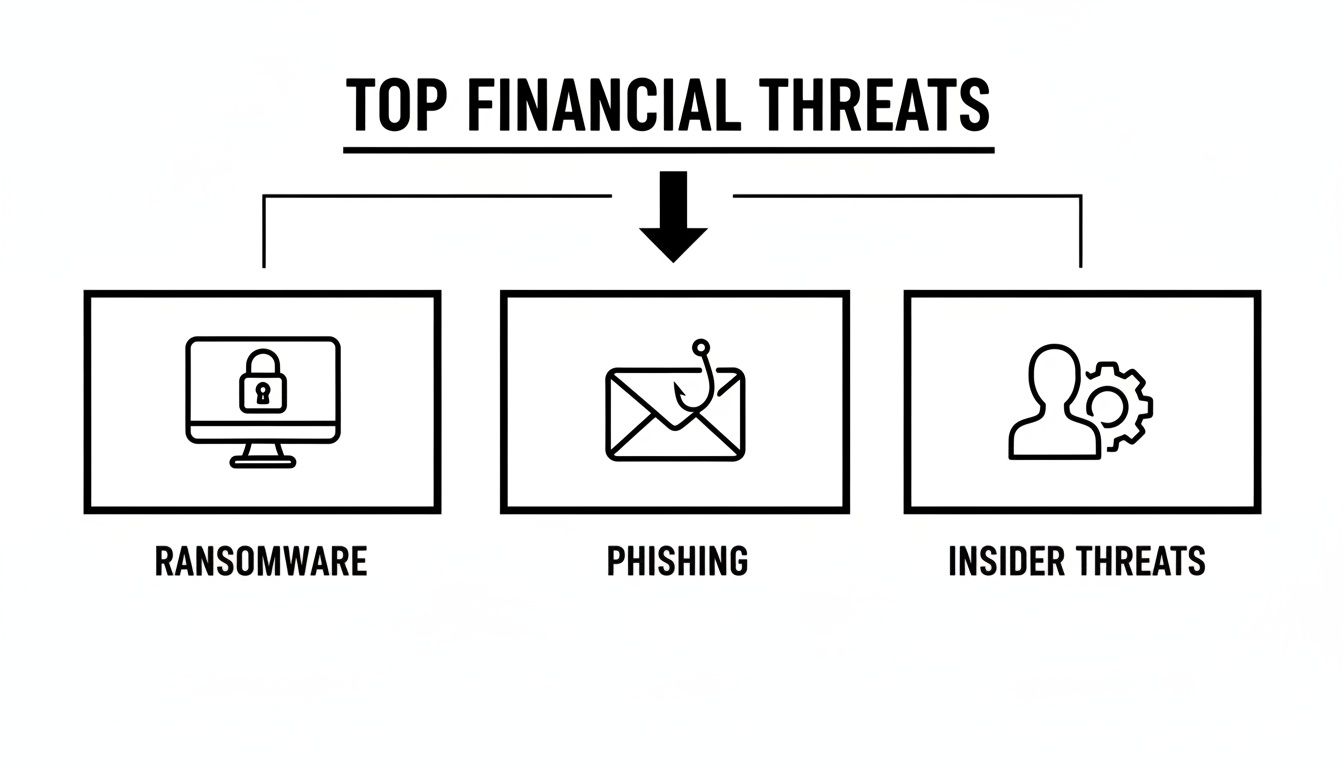
This visual drives home the point that threats come from everywhere—external attacks like ransomware and phishing, as well as from inside your own walls. This is why a comprehensive, layered defense is non-negotiable.
EDR: Your Digital Guards on Every Device
Think of Endpoint Detection and Response (EDR) as highly trained digital guards stationed on every single endpoint in your organization—every laptop, server, and workstation. It's a massive upgrade from traditional antivirus software, which just scans for known threats. EDR, on the other hand, watches device behavior in real time.
EDR solutions are constantly looking for suspicious activities that scream "attack in progress," like:
- A user's machine suddenly trying to encrypt thousands of files (a classic sign of ransomware).
- A common application like Microsoft Word attempting to run unusual scripts.
- An unauthorized process trying to access and ship data offsite.
When EDR spots a threat, it takes immediate, automated action. It can instantly isolate a compromised device from the network to stop an attack from spreading and give security analysts a detailed forensic trail of exactly what happened. This is how you contain breaches before they become business-ending disasters.
Managed SIEM: Your Central Intelligence Hub
While EDR protects individual endpoints, a managed SIEM is the central intelligence hub for your entire IT environment. It pulls in, connects the dots, and analyzes security logs from every corner of your network—firewalls, servers, cloud apps, and your EDR solution itself.
A managed SIEM acts like a security operations center (SOC) that never sleeps. It pieces together clues from different systems to spot complex, coordinated attacks that a single tool would miss entirely.
For example, your SIEM can correlate a phishing alert from your email gateway with a suspicious login on a critical server and an EDR alert on an executive’s laptop. Separately, they’re just noise. Together, they reveal a full-blown account takeover attempt in progress, allowing for a swift, targeted response.
Without a SIEM, all this critical data sits in isolated silos, making it nearly impossible to see the big picture. With a managed SIEM, you get unified visibility, enabling faster threat detection, deeper investigations, and the detailed audit trails you need to satisfy regulators like FINRA and the NY SHIELD Act. Together, EDR and SIEM form the powerful one-two punch that makes a Zero Trust architecture a reality.
Securing Your Firm's Migration to the Cloud

Moving your operations into cloud platforms like Microsoft Azure and Microsoft 365 isn't just a technical shift—it's a fundamental change in your security obligations. It unlocks incredible efficiencies, but simply "lifting and shifting" your data is a recipe for disaster. You must master a new set of responsibilities to keep that data safe.
The starting point is the shared responsibility model. Think of it like renting a high-security apartment. Microsoft, as the building owner, is responsible for the security of the building itself—the physical locks, concrete walls, and secure infrastructure.
But you are still responsible for everything inside your apartment. You must lock your own front door, decide who gets a key, and secure your valuables. In the cloud, this means your firm is fully accountable for securing its data, managing user access, and correctly configuring the services you use.
Mastering Your End of the Bargain
Misunderstanding this division of labor is one of the most common and dangerous mistakes firms make. According to Gartner, through 2025, a staggering 99% of cloud security failures will be the customer's fault. This is almost always due to misconfigurations and poor access management, highlighting the urgent need to actively manage your cloud environment.
To get it right, focus on three key areas: identity and access management, data governance, and threat monitoring. These are the digital locks, safes, and alarm systems for your cloud operations.
Here are actionable strategies you can implement right away to fortify your cloud environment.
Locking Down Access with Conditional Access Policies
Your first and most critical action is to control who can access your resources and under what conditions. Microsoft Entra Conditional Access (formerly Azure AD) is the tool for this job, acting as a smart, automated gatekeeper for your entire digital estate.
Instead of just checking a username and password, Conditional Access policies evaluate multiple signals before granting access. It asks questions like:
- User Location: Is this login from a trusted office or an unrecognized country?
- Device Health: Is the device compliant with your security policies and free of malware?
- Application Sensitivity: Is the user trying to open a routine file or a folder full of sensitive client financials?
- Real-time Risk: Is this account showing signs of being compromised?
Based on those signals, you enforce specific actions. For example, create a policy that requires multi-factor authentication (MFA) for anyone attempting to access sensitive financial apps from outside the corporate network. This single control is one of the most powerful defenses against compromised credentials.
By enforcing strict, context-aware controls, you stop being reactive. You start proactively verifying every single access attempt, which is the cornerstone of both Zero Trust and robust financial services data security.
Protecting Data with Microsoft Purview
Once you’ve locked down access, the next job is to protect the data itself. Financial firms handle massive amounts of non-public information (NPI), and you absolutely must know where it is, who is using it, and how to stop it from leaking. Microsoft Purview is the tool built for this job.
Use Purview to set up automated policies that classify and protect sensitive data. For instance, create a rule that automatically applies a "Confidential" label to any document containing credit card numbers, Social Security numbers, or other NPI.
These labels travel with the data, enforcing protection like encryption and access restrictions wherever the file goes—even if it's emailed outside your organization. This is a non-negotiable for maintaining compliance. For a closer look at how these frameworks intersect, you can learn more by tailoring cloud migration for FINRA compliance in our NYC playbook.
Monitoring Threats with Microsoft Sentinel
Finally, you need a security operations center for your cloud. Microsoft Sentinel is a cloud-native SIEM that gives you a single pane of glass for threat detection across your entire digital world—from Microsoft 365 and Azure to other clouds and even on-premises systems.
Configure Sentinel to use its built-in AI to analyze mountains of security data, connecting the dots to find sophisticated attacks that might otherwise fly under the radar. It can spot suspicious sign-ins, unusual data transfers, and other red flags, allowing your team to respond immediately. By establishing this kind of strong cloud governance, you ensure your environment isn't just functional—it's secure and compliant from day one.
Why Partnering with a Managed Security Service Pays Off
Trying to maintain a robust financial services data security program in-house is a monumental task. It demands constant vigilance, deep expertise, and a heavy investment in technology—three things most financial firms simply can't spare.
This is exactly where a Managed Security Service Provider (MSSP) changes the game, acting as a strategic force multiplier.
Think of an MSSP as the specialized general contractor for your entire security operation. While your team stays focused on core business goals, the MSSP handles the complex technical details, fine-tunes the security tools, and delivers a resilient, compliant, and constantly monitored defense system.
The Power of a 24/7 Security Operations Center
Threats don't stick to business hours, and your security monitoring can't afford to, either. A core advantage of partnering with an MSSP is gaining access to a dedicated Security Operations Center (SOC) that runs around the clock. This team of expert analysts delivers 24/7/365 threat monitoring and response.
This constant oversight is what stops attacks in their tracks. For example, a SOC can spot and neutralize a ransomware attack that kicks off at 2 a.m. on a Saturday, preventing it from spreading and causing catastrophic damage long before your team even logs in Monday morning.
Deep Expertise and Advanced Tool Management
Modern security tools like SIEM and EDR are incredibly powerful, but they're also notoriously complex. Getting them deployed, tuned, and managed effectively is a full-time job in itself. An MSSP brings a team of specialists who live and breathe this technology every single day.
They ensure your tools are configured correctly to cut through the noise of false positives and catch genuine threats. This expertise is what makes your security architecture truly operational. The team provides the threat intelligence and skilled analysis needed to turn raw data from security logs into actionable insights, stopping attackers before they can ever get a foothold.
Curious about how different services stack up? Check out our guide on how different managed detection and response services compare to see the value of specialized security management.
A partnership with a capable MSSP shifts your security posture from a cost center to a strategic investment. It provides the operational resilience and compliance assurance needed to enable secure business growth.
Navigating the Evolving Threat and Compliance Landscape
The rules and the risks are always changing. An MSSP acts as your guide through this shifting landscape, helping you stay ahead of new threats and evolving regulations like FINRA and the NY SHIELD Act. The consequences of falling behind can be enormous.
Take the 2019 First American Financial Corporation breach, which compromised a staggering 885 million records and became the largest financial sector breach in recent history. As you can read in the full research about major data breaches, a single vulnerability can have devastating results.
An MSSP provides the proactive guidance and continuous improvement needed to fortify your defenses against these large-scale incidents, ensuring your firm is prepared for whatever comes next.
Ready to build a resilient, compliant security program without the operational burden? The U.S.-based engineers at CitySource Solutions act as an extension of your team, delivering 24/7 SOC monitoring, managed SIEM/EDR, and strategic guidance to protect your firm. Transform your IT into a reliable platform for growth with CitySource Solutions.