
Think of a digital transformation framework as the strategic GPS for your business's future. It's not a dry technical checklist but an actionable blueprint that guides your journey, ensuring your people, processes, and technology are all aligned toward achieving your most important business goals. This structured approach is what turns ambitious digital ideas into measurable business wins.
What Exactly Is a Digital Transformation Framework?
Imagine trying to drive cross-country without a map or GPS. You might get somewhere, but you'll hit dead ends, waste resources, and never reach your destination efficiently. Many businesses approach digital transformation this way—launching scattered projects without a unifying plan. The result? Wasted money and stalled progress.
A digital transformation framework is that essential map. It's a structured game plan designed to link every digital initiative back to core business objectives, ensuring technology serves the strategy, not the other way around.
Beyond a Simple Checklist
A common mistake is treating a framework like a shopping list for new technologies. It’s a holistic guide that organizes the entire effort, preventing the siloed projects that so often cause these initiatives to fail.
Consider this: while the buzz around digital transformation is everywhere, the reality is that only 35% of global initiatives actually succeed. This statistic is a clear call to action. A solid framework is non-negotiable for businesses like financial services firms needing to achieve PCI-DSS compliance or manufacturing companies working to secure their OT/IoT environments.
A practical framework forces you to focus on the key areas that drive success:
- People: It provides a plan for change management, addressing the employee training and cultural shifts needed to make new ways of working stick.
- Process: The framework helps you pinpoint and execute opportunities to streamline workflows, automate repetitive tasks, and build real operational efficiency.
- Technology: It guides the selection of tools—from cloud infrastructure to data analytics—that directly support specific business outcomes.
- Governance: It establishes clear ownership, decision-making channels, and the metrics you need to track progress and prove ROI.
Why Structure Is Non-Negotiable
For industries operating under strict rules like HIPAA in healthcare or FINRA in finance, a framework is essential. It helps you build security and compliance into the transformation process from the very beginning, instead of treating them as an afterthought. This security-first approach isn't just about avoiding fines; it's about building an organization that's resilient and trustworthy from the ground up.
By providing a clear, repeatable structure, a digital transformation framework turns a chaotic, high-risk endeavor into a manageable and predictable journey. It ensures every dollar spent and every hour invested moves the organization closer to its strategic goals.
Ultimately, a framework provides the guardrails needed to navigate the complexities of modernizing a business. To build and execute one effectively, you must first understand the common digital transformation challenges that can derail even the most well-intentioned plans. It’s the bridge between having a bold vision and seeing tangible, lasting results.
Comparing the Most Effective Framework Models
Navigating the world of digital transformation frameworks can feel like staring at a dozen different maps. Each one promises the best route, but the right one depends on your starting point, your business, and your specific destination.
The goal isn’t to find the single “best” map, but the one that provides the most direct route for your journey. Let's break down three influential models—McKinsey's 7S, MIT's model, and Gartner's framework—so you can decide which one aligns with your organization's real-world needs.
McKinsey’s 7S Framework: Your Internal Alignment Tool
Imagine your organization as a machine with seven interconnected gears. If one is out of sync, the whole machine stalls. That’s the core idea behind McKinsey’s 7S Framework. It’s an actionable diagnostic tool to ensure every part of the business is aligned before and during a major change.
This model isn't a step-by-step tech roadmap. It’s a health check for your organization. The seven gears are:
- Hard Elements (Easy to define): Strategy, Structure, Systems.
- Soft Elements (Harder to nail down): Shared Values, Skills, Style, Staff.
Use the 7S model to diagnose internal friction. It’s the perfect starting point if your digital efforts are fizzling out and you can’t figure out why. It prompts you to ask critical questions like, "Do our people actually have the skills and leadership support to make this new CRM system work?"
Actionable Example: A mid-sized manufacturing firm rolled out a new IoT sensor system (Systems) to predict equipment failures, but adoption was poor. Using the 7S framework, they identified that their rigid, top-down management approach (Style) and lack of data analysis training (Skills) were the real roadblocks. Fixing those "soft" elements was the key to unlocking the technology's value.
MIT CISR’s Model: The Agile Foundation Builder
While McKinsey focuses on internal alignment, the model from MIT’s Center for Information Systems Research (CISR) is all about building a solid yet flexible foundation for the future. Instead of changing everything at once, you create a strong "operational backbone" and a nimble "digital services platform."
Think of the operational backbone as the sturdy plumbing and electrical systems in a house—your core, standardized processes like finance and HR that must work reliably. The digital services platform is the smart home tech you can easily plug in and upgrade, like a new customer-facing app or a data analytics tool.
This framework is ideal for businesses that need to become more agile without disrupting core operations. It encourages a two-speed approach: keep the core stable while you innovate quickly on the edges. This is a huge advantage in fast-moving industries where you must adapt to market shifts or seize new opportunities.
Gartner’s Digital Business Framework: The Value-Driven Roadmap
Too many transformation projects fail because they can't demonstrate their worth. Gartner's framework directly addresses this by drawing a straight line from your data maturity to your business outcomes. It’s built for leaders who need to justify every dollar spent and show a measurable ROI to the board.
Gartner's model helps you tie every initiative back to real business value, preventing you from adopting new tech for its own sake. It is structured to link your digital goals directly to enterprise strategy and customer needs. This makes it easier to track progress with business-centric KPIs, not just abstract IT metrics.
For companies that are data-rich but insight-poor, this framework provides a structured way to turn information into a strategic asset. It's less a single methodology and more a continuous cycle of measurement, learning, and proving value.
Digital Transformation Frameworks at a Glance
Use this table as a quick-start guide to find the right framework for your transformation.
| Framework | Core Focus | Best For | Key Components |
|---|---|---|---|
| McKinsey’s 7S | Holistic internal alignment of all organizational elements. | Organizations with cultural resistance or internal misalignment holding them back. | Strategy, Structure, Systems, Shared Values, Skills, Style, Staff. |
| MIT CISR’s Model | Building a stable operational core alongside an agile digital platform. | Companies needing to innovate quickly without breaking core, essential processes. | Operational Backbone (standardized systems) and Digital Services Platform (agile, customer-facing tech). |
| Gartner’s Model | Connecting data maturity and technology initiatives directly to business value. | Mature enterprises that need to prove the ROI of their digital investments to stakeholders. | Business Outcomes, Digital Capabilities, Enterprise Strategy, Data & Analytics Maturity. |
Ultimately, choosing the right path forward means being honest about your biggest challenges. You might even find that blending concepts works best. You could use McKinsey's 7S to get your teams aligned, adopt MIT's model to structure your technology, and apply Gartner's principles to measure what matters.
For a deeper look at specific technology roadmaps, check out our guide comparing popular cloud adoption frameworks.
The Five Pillars of a Resilient Transformation Strategy
Choosing a framework gives you the map, but a successful transformation needs a rock-solid foundation. Think of it like building a skyscraper: a blueprint isn't enough; you need massive structural pillars to hold everything up. The most durable digital transformation frameworks rest on five such pillars: People, Process, Technology, Governance, and Security.
Neglecting even one of these pillars makes the entire project wobbly, creating a shaky structure that can't deliver lasting value. Let's dig into each pillar and the practical steps you can take to strengthen it.
People: The Engine of Change
Technology doesn't implement itself. The success or failure of any digital project comes down to your people. This pillar is about fostering a culture that embraces change and equipping your team with the skills to succeed with new tools.
Without genuine buy-in, even the best software will sit unused. Real adoption only happens when employees understand why the change is happening and see how it improves their work.
Actionable strategies for the People pillar:
- Create a Real Change Management Plan: Go beyond a single memo. Build a clear communication strategy that addresses employee concerns, celebrates small wins, and provides consistent updates. Leadership must visibly champion the plan.
- Invest in Targeted Upskilling: Generic training is ineffective. Identify the specific skills your team needs for new technologies and roles, then offer tailored learning paths, mentorship programs, and hands-on workshops.
- Empower Change Champions: Identify enthusiastic employees at every level who can act as internal advocates. Give them the resources to share success stories and support their coworkers, building positive momentum from within.
Process: The Blueprint for Efficiency
Outdated, manual processes slow your operations down. This pillar focuses on redesigning your workflows to be faster, smarter, and more automated. The goal is to eliminate bottlenecks and create hyper-efficient operations that benefit both staff and customers.
This isn’t about digitizing old paper forms. It's a chance to completely rethink how work gets done, removing redundant steps and finding new efficiencies.
A classic mistake is automating a broken process. All that does is help you do the wrong thing faster. Real process transformation means looking at the entire workflow from start to finish and rebuilding it for how we work today.
One of the most significant trends here is hyperautomation, which uses a mix of tools like Robotic Process Automation (RPA), AI, and low-code platforms to automate just about everything. This isn't just a buzzword; the hyperautomation market was valued at USD 46.4 billion in 2024 and is expected to surge at a 17% CAGR through 2034. It's becoming the engine for frameworks that demand speed and precision. This trend works hand-in-hand with composable architectures, a market set to hit USD 39,366.6 million by 2032 at a 24.9% CAGR. This approach allows businesses to build systems with plug-and-play modules using microservices and APIs—a perfect fit for industries like manufacturing trying to secure IoT devices while adapting to rapid changes. You can discover more insights about digital transformation on rishabhsoft.com to see how these trends fit together.
Technology: The Toolbox for Innovation
The technology pillar is often the most visible, but it must be driven by strategy, not hype. It’s about choosing and implementing the right tools—from cloud platforms to data analytics—that directly support your business goals.
Your tech stack must be agile, scalable, and secure. It should be a flexible foundation you can build on for years to come.
Key technology considerations include:
- Smart Cloud Migration: Don't just "lift and shift" old servers to the cloud. Use the migration as an opportunity to modernize your applications, reduce costs, and leverage powerful cloud-native services.
- Data-Driven Decision Making: Implement robust data analytics platforms that turn raw information into clear, actionable insights. This empowers your teams to make smarter, faster decisions based on evidence, not just intuition.
- Composable Architecture: Move away from monolithic, all-in-one systems. Adopt a composable approach using APIs and microservices. This lets you build a flexible tech stack where you can easily swap components in and out as your business needs evolve.
Governance: The Guardrails for Success
Without clear governance, even the best transformation plans can go off track. This pillar is about setting the rules of the road: defining ownership, establishing clear KPIs, and creating decision-making processes that keep the entire effort on course.
Good governance creates accountability and provides the data needed to prove ROI to stakeholders. It answers the critical questions: "Who is in charge of this?" and "How do we know if we're succeeding?"
To implement effective governance, you should:
- Form a Transformation Office: Create a dedicated, cross-functional team to oversee the program, manage the budget, and resolve conflicts.
- Define What Success Looks Like: Establish clear, measurable KPIs tied directly to business outcomes, like lower operating costs, higher customer satisfaction, or faster time-to-market.
- Establish Clear Ownership: Ensure every project and initiative has a designated owner. This creates accountability and prevents projects from stalling.
Security: The Unshakeable Foundation
Finally, security cannot be an afterthought—it must be the bedrock of your entire strategy. With rising cyber threats, a transformation that creates new vulnerabilities isn't a transformation at all; it's a liability.
Building security into every phase of your framework from day one de-risks the entire journey and builds customer trust. A Zero Trust mindset, which assumes no user or device is trusted by default, should be your starting point. It's about verifying every access request, regardless of its origin.
Partnering with a security-first managed service provider to implement a 24/7 Security Operations Center (SOC) and managed SIEM (Security Information and Event Management) provides the constant monitoring needed to detect and neutralize threats in real-time. This ensures your transformation is both innovative and secure.
Your Step-By-Step Implementation Roadmap
Picking the right digital transformation framework gives you the blueprint. But turning that blueprint into a finished structure requires a clear, step-by-step construction plan. Without a phased roadmap, even the most brilliant strategy can collapse.
This guide breaks the implementation process into five manageable stages to help you turn strategic vision into tangible action.
This flowchart shows how people, processes, and technology are interconnected, guided by strong governance and fortified by security from start to finish.
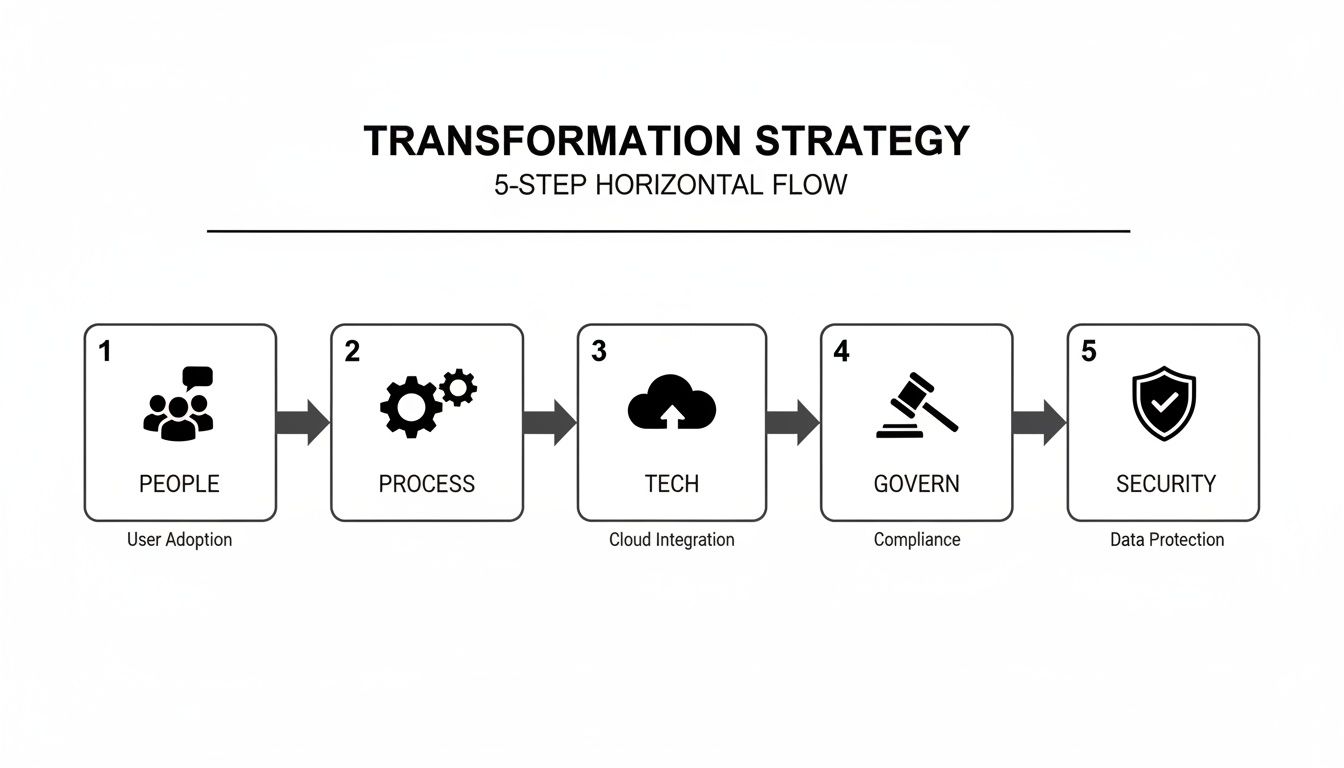
As you can see, a successful strategy isn’t a straight line—it’s a continuous loop. Each element influences the next, creating a business engine that's both resilient and ready to adapt.
Stage 1: Assessment and Vision
Before you build, you must survey the land. This first stage is a thorough audit of your current state—your team's skills, process efficiency, and existing technology capabilities. This isn't just about finding flaws; it's about identifying strengths you can leverage.
With a clear baseline, define a compelling vision for the future. A vague goal like "become more digital" is not enough. Your vision must be a specific, measurable outcome tied to business value, such as "reduce customer onboarding time by 50% in 18 months" or "increase supply chain efficiency by 30%."
A clearly articulated vision acts as your North Star. It aligns stakeholders, motivates teams, and provides a filter for every decision you make throughout the implementation journey.
Stage 2: Strategy and Framework Selection
With your vision defined, build the strategic case and choose the right framework. This involves creating a detailed business case that outlines the expected ROI, identifies potential risks, and secures the necessary budget and executive sponsorship. Gaining buy-in at this stage is critical for long-term momentum.
Based on your specific goals, select or customize a framework. If internal misalignment is your biggest hurdle, McKinsey’s 7S is a good fit. If you need to innovate quickly without disrupting core operations, the MIT CISR model provides a clear path. The key is to choose a structure that provides relevant guardrails for your unique journey.
Stage 3: Pilot and Execution
"Big bang" transformations are notoriously risky. A smarter approach is to start small, prove value, and build momentum. The pilot stage is where you test your strategy on a limited scale. Select a single, high-impact project that can deliver a quick win and serve as a proof of concept.
For example, a healthcare clinic might pilot a new telehealth platform with a small patient group before a full rollout. This allows the team to resolve issues, gather real-world feedback, and create a success story that builds confidence across the organization. This is also where foundational tech changes begin, making it essential to follow cloud migration best practices for a secure and smooth transition.
Stage 4: Scale and Optimize
Once your pilot project proves successful, it’s time to scale. This stage involves taking the lessons learned from the pilot and applying them to a broader rollout across departments or the entire organization. This isn't a simple copy-and-paste process; each implementation will require adjustments based on the specific needs of different teams.
Continuous optimization is the engine of this stage. Establish a tight feedback loop where you constantly collect data, measure performance against your KPIs, and refine your processes. This iterative approach ensures your transformation gains strength as it expands, rather than losing momentum.
Stage 5: Embed and Evolve
The final stage is about making the change permanent. The goal is to shift from a "transformation project" to a new state of "business as usual," where digital agility is woven into your company’s DNA. This means embedding new processes, skills, and mindsets into your daily operations.
This requires ongoing effort. You'll need to focus on:
- Continuous Training: Keep your team's skills current with ongoing learning opportunities.
- Reinforce New Behaviors: Align performance metrics and rewards with the new ways of working.
- Foster Innovation: Create a culture where experimentation is encouraged and failure is treated as a learning opportunity.
Ultimately, a successful implementation doesn’t have a finish line. It cultivates an organization that is perpetually ready to adapt, innovate, and evolve in response to market or technological changes.
Measuring the True Impact of Your Transformation
Rolling out a digital transformation framework is a major investment. But how do you know if it's actually working? Launching new software isn't proof of success. To justify the investment and make data-driven decisions, you must measure what matters.
This means moving past surface-level "vanity metrics" and focusing on key performance indicators (KPIs) that tie directly to business value. A smart measurement strategy doesn't just report on the past; it provides the insights you need to steer the initiative and ensure every dollar delivers a clear return.
From Vague Goals to Concrete KPIs
The saying, "If you can't measure it, you can't manage it," is your guide here. The most effective digital transformation roadmaps bake measurement in from the start. This is about translating broad strategic goals into specific, quantifiable metrics that tell a clear story of progress across the business.
Let's break down how to track success in a way that demonstrates impact to stakeholders and keeps your team focused on the right targets.
Key Performance Indicators Across Your Business
Your success dashboard should provide a complete picture of the transformation's impact. Here are the must-have categories and KPIs to track, with real-world examples of what they look like in action.
1. Operational Efficiency
This measures how new tools and processes are making the business run smoother, faster, and cheaper. Are you getting more done with less?
- Process Automation Rate: Track the percentage of tasks that are now automated. For example, a finance team could aim to automate 80% of its invoice processing, freeing up staff for more strategic work.
- Cycle Time Reduction: Measure the time it takes to complete a process from start to finish. A manufacturing firm could track the reduction in time from customer order to product shipment.
- Operational Cost Savings: Calculate direct cost reductions from new efficiencies, like lower software licensing fees or reduced hours spent on manual data entry.
2. Customer Experience (CX)
Here, you measure how the transformation improves customer interactions with your brand. The goal is happier, more loyal customers.
- Net Promoter Score (NPS): This classic metric gauges customer loyalty by asking how likely they are to recommend you. A rising NPS is a strong indicator of CX success.
- Customer Effort Score (CES): This measures how easy it is for customers to resolve an issue. A lower score is better, indicating you are removing friction.
- Digital Channel Adoption: Track the percentage of customers using new digital tools, like a mobile app or self-service portal. This shows your investments are meeting customer needs.
3. Employee Enablement
A transformation will fail if your team doesn't adopt the changes. These metrics track whether employees are using and benefiting from the new ways of working.
Tracking employee metrics is non-negotiable. Low adoption is the single biggest early warning sign of failure. If your team isn't using the new systems, you'll never see the promised ROI.
- Digital Tool Adoption Rate: Measure how many employees are actively using the new platforms. An adoption rate below 75% is a red flag that may signal a need for better training or change management.
- Employee Satisfaction Score (eNPS): Like the customer version, this tracks how likely employees are to recommend your company as a great place to work. Happier employees are more productive.
- Time to Productivity: How long does it take a new or retrained employee to reach full productivity with new systems? A shorter time indicates effective onboarding and tools.
4. Financial Impact
Ultimately, every initiative must connect to the bottom line. These are the hard numbers that executives and the board require to justify continued investment.
- Return on Investment (ROI): This is the ultimate proof of financial success. It calculates the profitability of your transformation investments against their cost.
- Customer Lifetime Value (CLV): Track the total revenue a customer is expected to generate. Digital improvements should increase this number.
- Revenue Growth from Digital Channels: Isolate the revenue generated specifically through your new digital products or services. This proves they are real revenue drivers.
A well-crafted KPI template can bring all of this together, giving you a clear, at-a-glance view of your progress. It helps translate abstract goals into concrete numbers that everyone can understand and rally behind.
Essential Digital Transformation KPI Template
Use this sample template to measure the tangible impact of your transformation initiatives across key business domains.
| Category | KPI | Example Metric | Business Goal |
|---|---|---|---|
| Operational Efficiency | Process Automation Rate | Percentage of invoices processed automatically | Reduce manual effort and errors |
| Operational Efficiency | Cycle Time Reduction | Time from customer order to shipment | Improve order fulfillment speed |
| Customer Experience | Net Promoter Score (NPS) | Score on a -100 to 100 scale | Increase customer loyalty and referrals |
| Customer Experience | Digital Channel Adoption | % of support tickets resolved via self-service | Lower support costs and empower users |
| Employee Enablement | Digital Tool Adoption Rate | % of employees actively using new CRM | Maximize ROI on technology investment |
| Employee Enablement | Employee Satisfaction (eNPS) | Score based on employee feedback | Boost morale and reduce turnover |
| Financial Impact | Return on Investment (ROI) | (Net Profit / Cost of Investment) x 100 | Justify transformation expenditures |
| Financial Impact | Revenue from Digital Channels | $ value of sales from new e-commerce site | Drive new, scalable revenue streams |
By building a dashboard with these kinds of KPIs, you create more than just a report—you create a strategic tool. It’s your guide for demonstrating value, making smarter decisions, and ensuring your digital transformation journey stays on the path to success.
Why Your Transformation Must Be Security-First

Starting a digital transformation without integrating security from the start is like building a skyscraper on a foundation of sand. It's only a matter of time before it all collapses. In a world where a single breach can destroy years of progress, a security-first mindset isn't just a good idea—it’s essential for building a resilient business.
This is non-negotiable for any organization handling sensitive data, especially those bound by regulations like HIPAA, PCI-DSS, or FINRA. Ignoring security isn't just risky; it's an invitation for disaster.
Shifting from Cost Center to Strategic Enabler
For too long, security was treated as a cost center or the final hurdle before a project could launch. A modern digital transformation framework flips that outdated thinking. It reframes security as a strategic driver of growth and trust.
When security is woven into your transformation from day one, it makes the entire process safer and more predictable. Implementing principles like Zero Trust—where you verify every access request, no exceptions—and setting up continuous threat monitoring doesn't slow things down. It creates the guardrails you need to innovate with confidence.
A secure transformation is the only kind that builds lasting customer trust. It signals to your clients and partners that you are a responsible custodian of their data, creating a powerful competitive advantage.
A structured model like the Three Lines of Defense framework for AI Governance and Risk Management can help you embed risk management into your strategy, not just tack it on at the end. It also pays to get ahead of common vulnerabilities; you can learn more about common cloud security risks in our article here: https://citysourcesolutions.com/cybersecurity/cloud-security-risks/
The Immense Scale of Digital Risk and Reward
The scale of this digital shift is massive. The global digital transformation market, valued at USD 1.49 trillion in 2025, is projected to explode to USD 12.53 trillion by 2035. That growth, at a 23.73% compound annual rate, represents a huge opportunity.
But with opportunity comes risk. Every new digital tool, from a cloud application to an IoT sensor, expands your attack surface. A security-first approach ensures that as your business adopts new tech, your defenses grow alongside it.
At the end of the day, a secure transformation isn’t just about avoiding fines. It's about building a resilient business that can thrive in an increasingly complex digital world.
Answering Your Digital Transformation Questions
Embarking on a digital transformation journey always raises questions. Here are straightforward answers to the most common ones to help you move forward with confidence.
What Makes a Good Digital Transformation Framework?
A strong framework is a flexible guide, not a rigid rulebook. It adapts to your business while providing a clear path forward. The most critical element is a direct link between every tech initiative and a measurable business goal. If you can't connect the dots, reconsider the initiative.
Most importantly, a solid framework must balance all five pillars: people (skills and culture), processes (how work gets done), technology (the right tools), governance (clear ownership), and security integrated from the start.
How Do We Choose the Right Framework to Start?
First, define your primary business objective. Are you trying to improve internal alignment, boost operational efficiency, or create new digital products? Your goal will point you toward the right model.
- For internal alignment challenges, start with McKinsey's 7S.
- For operational excellence, a process-first model like Lean Six Sigma is effective.
- For rapid innovation, an agile framework like the MIT CISR's model is a great fit.
Don't feel locked into one model. The best strategies often blend elements from different frameworks to create a custom approach that meets your specific needs.
How Can We Get Employee Buy-In for These Changes?
Employee resistance is a top reason why transformation initiatives fail. The key to gaining team support is effective change management.
Build support by explaining the "why" behind the change, not just the "what." Show your teams how the new tools and processes will genuinely make their jobs easier, and pull them into the implementation process as early as you can.
You can also create a network of "change champions" within your teams. These are influential employees who can build momentum from the ground up and help address concerns before they become roadblocks.
A successful transformation is a complex undertaking, but you don't have to go it alone. CitySource Solutions delivers the security-first IT strategy and support you need to guide your journey. From cloud migration to continuous cybersecurity management, we help ensure your digital initiatives are built on a secure and resilient foundation. Learn how our managed services can de-risk your transformation.