
When we talk about cloud security risks, we're really talking about any threat that could compromise your data, applications, and infrastructure in a cloud environment. These aren't just sophisticated cyberattacks; they often stem from simple human error, like a misconfigured security setting. They can also be complex, targeting user identities or APIs, creating massive operational and compliance headaches for any business.
Why the Cloud Is Today's Top Target

Moving to the cloud offers incredible advantages for growth, but it completely rewrites the rules of security. A traditional on-premise network is like a fortress with a moat—you know exactly where your perimeter is. The cloud, on the other hand, is a dynamic, borderless environment, and that has made it the number one target for attackers.
The very things that make the cloud so powerful, like instant scalability and global accessibility, also open up new doors for threats. The shared responsibility model is another common pain point. While the cloud provider secures the underlying hardware, you are responsible for securing everything you put in the cloud. It's a partnership that, if misunderstood, leaves dangerous security gaps wide open.
The Scale of Modern Cloud Threats
This isn't just a theoretical problem—it's happening right now, constantly. Organizations are hit with a staggering 1,925 cyberattacks per week, on average. That breaks down to roughly 275 attacks every single day. These figures show just how relentlessly cybercriminals are hammering cloud environments worldwide. You can explore more data in the latest cybersecurity trends report from SentinelOne.
These attacks aren't just technical glitches; they are fundamental business risks. For a law firm, a data breach means shattered client trust and potential legal malpractice claims. For a healthcare provider, a ransomware attack can halt patient care and trigger crippling HIPAA penalties.
Think of your cloud environment like a bustling city. The provider builds the roads and runs the utilities, but you’re responsible for locking the doors and windows on every building you own—your apps, data, and configurations. An unlocked door is an invitation for trouble.
To get ahead of these challenges, you first need a clear picture of what you're up against. Here's a quick look at the top threats we see every day.
Top Cloud Security Risks at a Glance
This table summarizes the most common cloud security threats we'll be breaking down. It offers a quick, scannable overview before we dive into the details of each risk category.
| Risk Category | Primary Cause | Common Example |
|---|---|---|
| Misconfigurations | Human error or lack of policy | Leaving a cloud storage bucket (like AWS S3) public, exposing all its data. |
| IAM Failures | Overly permissive roles or stolen credentials | An attacker compromises a developer's account and gains admin-level access. |
| Insecure APIs | Poor authentication or validation | An API that allows unauthorized users to access or modify sensitive customer records. |
| Data Exposure | Weak encryption or insecure data transfer | Storing sensitive patient data in a database without proper encryption. |
Each of these risks can lead to significant data loss, operational downtime, and regulatory fines. Now, let’s explore them in more detail.
- Misconfigurations and Human Error: Simple mistakes, like leaving a storage bucket public, remain one of the most common causes of major data breaches. It’s the digital equivalent of leaving the vault door wide open.
- Identity and Access Management (IAM) Failures: Stolen credentials or accounts with far too many permissions give attackers the keys to your entire cloud kingdom.
- Insecure APIs and Interfaces: APIs are the connective tissue of the cloud. If left unsecured, they become an easy entry point for attackers to pull data out.
- Data Exposure and Leakage: Beyond misconfigurations, sensitive data can be exposed through poor encryption practices or insecure data transfer methods.
This guide will break down each of these critical cloud security risks and give you actionable strategies to build a resilient and secure digital foundation for your business.
Breaking Down the Most Common Cloud Security Risks

To effectively defend your cloud environment, you must know what you’re up against. These threats aren't abstract concepts; they are specific vulnerabilities with painful, real-world consequences. Each one is a different path an attacker might take to get past your defenses, much like a burglar checking for an unlocked window, a flimsy door, or an open garage.
Let's unpack the most critical cloud security risks one by one. We'll identify their root causes, show how they play out with practical examples, and provide actionable steps to mitigate them. This way, you'll understand not just what the risks are, but how to start fixing them. This knowledge is the bedrock of a strong defense.
The Unlocked Front Door: Misconfigurations
Cloud misconfigurations are, by far, the most common and damaging of all cloud security risks. The frustrating part? They are almost always preventable.
Think of it like accidentally leaving your office's front door unlocked with the alarm off overnight. It doesn't matter how strong your locks are if someone simply forgets to use them.
These errors appear when security settings aren't configured correctly, often due to human error, a lack of oversight, or the sheer complexity of modern cloud environments. A single mistake, like setting a private storage bucket to "public," can expose mountains of sensitive data to the entire internet. It's a common but incredibly dangerous oversight.
This chart from Check Point shows just how big of a challenge misconfigurations are in cloud security.
The takeaway is clear: preventable mistakes remain one of the biggest vulnerabilities for companies in the cloud.
Simple oversights, like unsecured storage buckets or overly permissive access controls, are a top threat driving a huge portion of all cloud incidents. You can dig deeper into these challenges in this detailed cloud security overview.
Actionable Fix: Implement a Cloud Security Posture Management (CSPM) tool. These solutions automatically and continuously scan your environment for common misconfigurations—like public S3 buckets or open database ports—and provide real-time alerts so you can fix them before an attacker finds them.
The Unguarded Loading Dock: Insecure APIs
If data is your company’s most valuable asset, then your Application Programming Interfaces (APIs) are the loading docks where it all moves in and out. APIs let different applications talk to each other and share data, powering everything from mobile apps to critical business workflows.
An insecure API is like an unguarded, unmonitored loading dock where anyone can just walk in and take whatever they want.
These vulnerabilities often stem from weak authentication, no rate limiting (which stops brute-force attacks), or poor data validation. Attackers actively hunt for these weak spots to get unauthorized access to systems and data. And because APIs are built for machine-to-machine speed, a single compromised API can lead to a massive, automated data theft in minutes.
Actionable Fix: Mandate strong API security hygiene. Start by enforcing robust authentication (like OAuth 2.0) for every API endpoint. Implement rate limiting to block brute-force attacks and use an API gateway to centralize monitoring and apply consistent security policies across all your APIs.
The Hidden Backdoor: Supply Chain Vulnerabilities
Your cloud security isn't just about what you build; it's also about the third-party code and services you rely on. Modern applications are assembled from countless open-source libraries, third-party software, and external services. This web of dependencies is your software supply chain.
A supply chain vulnerability happens when an attacker compromises one of these third-party components. Imagine a trusted parts supplier for a carmaker secretly installing a faulty component in every engine they ship. The car company would unknowingly build thousands of unsafe vehicles, creating a massive problem that’s incredibly hard to trace.
When you pull a compromised open-source library into your application, you’re essentially installing a backdoor into your own system. Attackers can then use that backdoor to steal data, disrupt services, or get a foothold to move deeper into your network. These attacks are especially nasty because they exploit the trust you have in your software suppliers.
Actionable Fix: Integrate software composition analysis (SCA) tools into your development pipeline. These tools scan your code for known vulnerabilities in open-source libraries and third-party dependencies, alerting you to risks before they are deployed into production. Maintain a software bill of materials (SBOM) to track every component in your applications.
The Threat From Within: Insider Risks
Not all threats come from the outside. An insider threat comes from someone who already has authorized access to your systems—an employee, a contractor, or even a former employee whose credentials were never revoked. These threats can be malicious or completely unintentional.
A malicious insider might deliberately steal data for financial gain or sabotage systems out of revenge. For instance, a disgruntled employee at a law firm could download a sensitive client case file before resigning and sell it to the other side. The damage is both immediate and catastrophic.
But honestly, unintentional insider threats are far more common. This happens when a well-meaning employee makes a mistake that creates a security hole.
Actionable Fix: Implement the principle of least privilege combined with comprehensive activity logging. Enforce strict role-based access control (RBAC) to ensure employees only access data essential to their jobs. Deploy user and entity behavior analytics (UEBA) tools to detect anomalous activity, such as an employee suddenly downloading unusually large amounts of data, and create a formal offboarding process to immediately revoke all access for departing employees.
Why Identity Is the New Security Perimeter
In the old days of office-based work, security was simple. You had walls, cameras, and a guard at the front desk. That was your perimeter. But in the cloud, your data and applications are scattered across a global, always-changing environment. The idea of a fixed, network-based perimeter is completely obsolete.
The new perimeter isn't a place; it's an identity. How you control who—and what—gets access is now the single most important security control you have. This has elevated Identity and Access Management (IAM) from a routine task to the absolute core of a modern cloud security strategy.
Think of it like this: your entire cloud infrastructure is a high-tech building with a sophisticated keycard system. Your goal is to ensure everyone inside can only access the specific rooms they need to do their jobs. You'd never hand a contractor a master key to every door; that would be an epic security failure. Yet, that’s exactly what happens when businesses grant over-privileged access in the cloud.
Common IAM Failures and How to Fix Them
Attackers get this. They've shifted from trying to smash through firewalls to stealing credentials so they can walk right in the digital front door. Unfortunately, many organizations make it easy for them through common IAM mistakes.
These gaps create massive cloud security risks. Once an attacker compromises an identity, they can often move through a system completely undetected, looking just like a legitimate user. The damage from just one compromised account can be catastrophic.
Here are the most frequent IAM mistakes and how to fix them:
Excessive Permissions: This is the big one. It’s the digital master key—a small breach that can quickly spiral into a full-blown disaster.
- Actionable Fix: Implement the principle of least privilege. Use IAM policies to grant only the absolute minimum permissions required for a user or service to function. Regularly review permissions and use automated tools to identify and remove excessive access rights.
Weak Credentials: Relying on simple, easy-to-guess passwords without any enforcement policies is basically leaving the door unlocked.
- Actionable Fix: Enforce a strong password policy that mandates complexity, length, and regular rotation. Better yet, move toward passwordless authentication methods where possible.
No Multi-Factor Authentication (MFA): Passwords alone just don't cut it anymore. Without MFA, a single stolen password is all an attacker needs.
- Actionable Fix: Make MFA mandatory for all users, especially those with privileged access. Implement solutions like advanced MFA and strong password security across your entire cloud environment. It's not optional—it's essential.
How Attackers Exploit Identity Gaps
The reality is that IAM flaws are fueling a huge wave of cloud breaches, with a high percentage involving compromised or misused privileged credentials. Phishing is still a go-to tactic, tricking users into handing over their logins and passwords.
Once they're in, attackers leverage overly permissive roles to escalate their privileges, move laterally across the network, and hunt for high-value targets like customer databases or financial records.
A compromised identity isn't just a technical problem; it's a direct business threat. An attacker with admin credentials can delete critical infrastructure, steal intellectual property, or deploy ransomware, leading to devastating operational downtime and financial loss.
Ultimately, a strong defense starts with adopting a "least privilege" mindset. This approach is a core part of any modern security framework. In fact, it's a key principle behind the strategies we cover in our guide on how to implement Zero Trust security.
By treating every access request with suspicion and granting only the absolute minimum permissions required, you transform identity from your biggest vulnerability into your strongest line of defense.
Connecting Cloud Risks to Your Compliance Obligations
For businesses in regulated industries, a technical vulnerability is never just a technical problem—it's a direct compliance failure waiting to happen. The cloud security risks we’ve discussed don't float in a vacuum; they map directly to the strict rules governing how you handle sensitive data.
Think of a compliance framework like a building code for your data. Just as a building inspector checks for fire safety and structural integrity, auditors check that your digital infrastructure meets specific security standards. A cloud misconfiguration isn't just a technical slip-up; it's a violation of that code, carrying serious legal and financial consequences.
Translating Threats into Regulatory Language
The key is to translate abstract threats into the concrete language of regulations. A misconfigured cloud storage bucket is more than a technical issue. For a healthcare provider, it’s a potential violation of HIPAA’s Security Rule, which demands strict controls over Protected Health Information (ePHI). For a financial firm, an insecure API could violate PCI-DSS requirements for protecting cardholder data.
This straight line between a cloud vulnerability and a compliance failure makes security a core business function. It's not just about protecting systems; it's about protecting the organization from fines, lawsuits, and reputational damage that can cripple operations.
Any unaddressed cloud security risk is a ticking compliance time bomb. The question isn't if an audit will find it, but when—and whether an attacker finds it first. Each risk directly undermines the controls mandated by frameworks like HIPAA, PCI-DSS, and the NY SHIELD Act.
Mapping Cloud Risks to Specific Compliance Frameworks
To make this connection crystal clear, let’s map the common cloud security risks to their corresponding compliance implications. Seeing these direct parallels helps both IT leaders and compliance officers speak the same language and prioritize protective measures.
Data Exposure and HIPAA: The HIPAA Security Rule requires covered entities to "implement technical policies and procedures for electronic information systems that maintain ePHI." An accidentally public cloud database stuffed with patient records is a textbook violation of this rule, triggering mandatory breach notifications and potentially millions in fines. Shockingly, more than half (51%) of healthcare organizations with sensitive data in cloud databases also have them publicly exposed.
Insecure APIs and PCI-DSS: The Payment Card Industry Data Security Standard (PCI-DSS) Requirement 6 mandates the development and maintenance of secure systems and applications. An insecure API that allows unauthorized access to cardholder data is a direct failure to meet this standard. The fallout? Steep fines and even losing the ability to process credit card payments.
IAM Failures and FINRA/NY SHIELD: Both FINRA rules and the New York SHIELD Act require firms to implement robust cybersecurity programs that include solid access controls. Overly permissive IAM roles or skipping multi-factor authentication would be seen as a failure to protect sensitive client financial or personal information, violating the core principles of these regulations.
To get a deeper look at aligning your cloud strategy with these mandates, check out our detailed guide on security-first cloud compliance best practices. It offers more practical insights for building a compliant cloud environment.
A Unified View of Risk and Compliance
Ultimately, a strong security posture and a compliant one are two sides of the same coin. Every control you implement to mitigate a cloud security risk also strengthens your compliance position. This table gives you a high-level view of how these concepts align, helping bridge the gap between your tech team and your compliance officers.
Cloud Risk and Compliance Framework Alignment
This table maps common cloud security risks to specific compliance requirements from HIPAA, PCI-DSS, and FINRA, helping businesses visualize their obligations.
| Cloud Security Risk | HIPAA Requirement | PCI-DSS Requirement | FINRA/NY SHIELD Implication |
|---|---|---|---|
| Data Misconfiguration | Failure to protect ePHI from unauthorized access. | Violation of controls for securing cardholder data. | Failure to provide reasonable security for private information. |
| IAM Failures | Inadequate access controls to systems handling ePHI. | Lack of unique access credentials and role-based controls. | Insufficient controls to manage user access to sensitive data. |
| Insecure APIs | Risk of unauthorized ePHI disclosure through interfaces. | Failure to secure public-facing applications. | Exposing sensitive financial or personal data to attack. |
| Insider Threat | Unauthorized access to ePHI by internal staff. | Failure to restrict access to cardholder data by job need. | Inadequate internal controls to prevent data misuse. |
By viewing cloud security through a compliance lens, you can build a more resilient and defensible organization. This approach moves security from an IT cost center to a critical component of business enablement and risk management.
Actionable Strategies to Mitigate Cloud Risks
Knowing the enemy is half the battle, but actually stopping cloud threats requires a deliberate, multi-layered defense. Moving from theory to practice means putting a clear set of policies, technical controls, and operational processes in place. This isn't about finding a single magic bullet; it's about building a resilient security posture that anticipates threats and neutralizes them before they can cause damage.
This playbook gives you actionable strategies your organization can implement today. We’ll cover foundational governance, essential technical controls like Zero Trust, and crucial operational processes like incident response. Each strategy is designed not just to check a box, but to directly counter the risks of misconfiguration, identity compromise, and data exposure we've discussed.
Establish Strong Policies and Governance
Before you deploy a single tool, you need a strong foundation of security governance. It all starts with creating clear, enforceable policies that define acceptable use, data handling, and access control for every cloud resource you have. A well-defined policy acts as the blueprint for your entire security program, ensuring everyone is on the same page.
Think of it as the building code for your cloud environment. Without it, every team builds to their own standards, which almost always leads to insecure, chaotic infrastructure. Good governance ensures everyone is working from the same secure design from day one.
These policies should include:
- Data Classification: Not all data is equal. A solid policy defines what’s sensitive (like PII, PHI, or financial records) and dictates the specific security controls needed to protect it, such as encryption and strict access restrictions.
- Acceptable Use: Clearly outline how employees and systems are allowed to interact with cloud services. This helps prevent risky behaviors, like storing sensitive data in unapproved locations.
- Identity and Access Management (IAM): Make the principle of least privilege official. This policy should mandate that users and services get only the absolute minimum permissions needed to do their jobs—and nothing more.
This diagram shows how various cloud risks are directly tied to major compliance frameworks like HIPAA, PCI-DSS, and FINRA.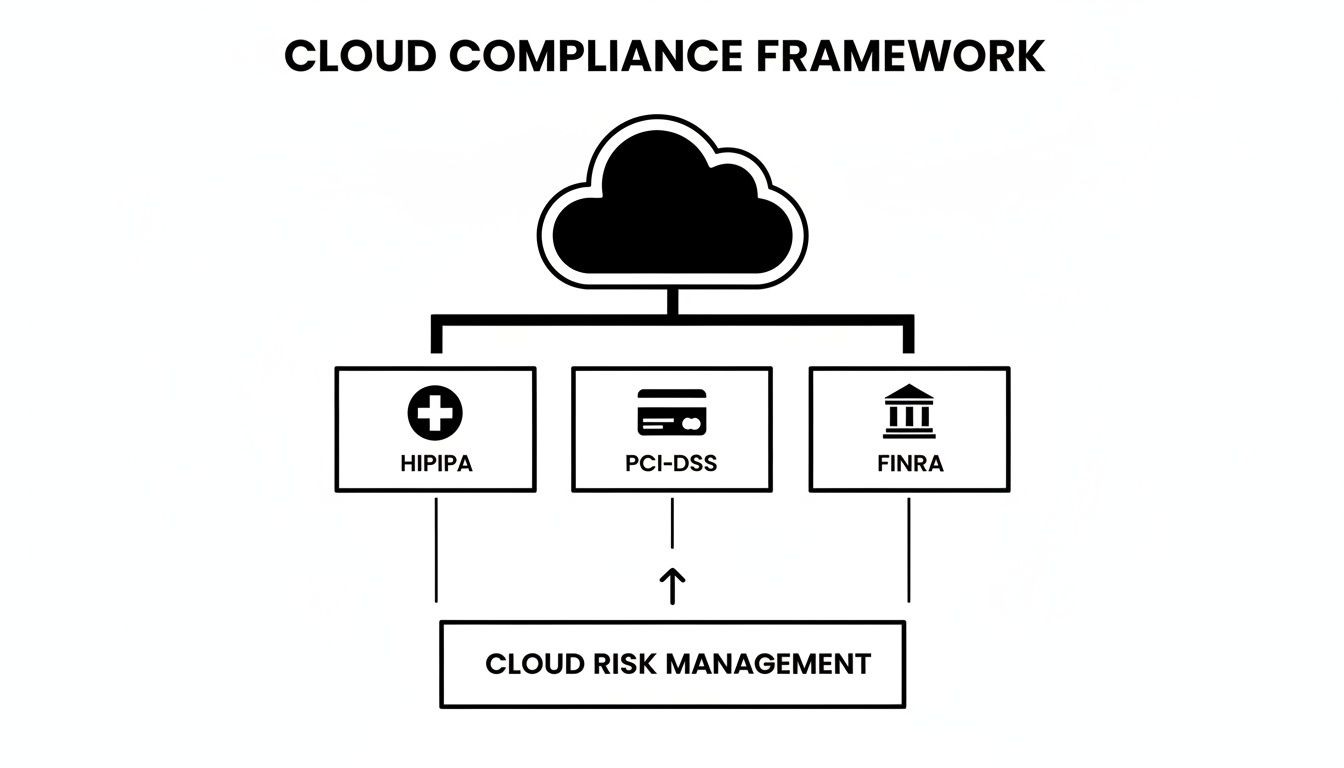
As you can see, a single cloud risk can have cascading compliance implications, which makes a unified governance strategy essential for any regulated business.
Implement Essential Technical Controls
With a solid policy foundation, you can start layering on technical controls to automate enforcement and actively defend your environment. These tools are your frontline soldiers, working 24/7 to block attacks and detect anomalies.
A modern security posture relies on several key technologies. The goal is to move from a reactive to a proactive model where security is built in, not bolted on. To effectively address identified vulnerabilities, explore proven Cloud Security Best Practices that outline these crucial controls.
Zero Trust Architecture: The core idea behind Zero Trust is simple but powerful: "never trust, always verify." This means you treat every access request—whether from inside or outside your network—as potentially hostile. Every user and device must be authenticated and authorized before getting access, which severely limits an attacker's ability to move laterally if they do manage to breach the perimeter.
Additional must-have technical controls include:
- Cloud Security Posture Management (CSPM): These tools continuously scan your cloud environments for misconfigurations and compliance violations. They automatically flag issues like public storage buckets or overly permissive IAM roles before an attacker finds them.
- Multi-Factor Authentication (MFA): Enforce MFA for all user accounts, especially privileged ones. This simple step adds a critical layer of protection against credential theft. It’s one of the most effective security measures you can take.
- Endpoint Detection and Response (EDR): You have to secure the devices that access your cloud resources. EDR provides advanced threat detection, investigation, and response on laptops, servers, and other endpoints.
Harden Your Operational Processes
Finally, technology alone isn't enough. Your security is only as strong as the operational processes that support it. These processes ensure your team can respond effectively when an incident occurs and that your security measures evolve with the threat landscape. For a deeper dive, review our guide on CitySource Solutions' cloud security best practices.
An effective operational security program includes:
Continuous Monitoring and Logging: You can't protect what you can't see. Implement comprehensive logging and monitoring to gain visibility into all activity across your cloud environment. This is absolutely critical for detecting suspicious behavior and for doing forensic analysis after an incident.
Incident Response (IR) Plan: Don't wait for a breach to figure out what to do. Develop and regularly test a formal IR plan that details step-by-step actions, including who to contact, how to contain the threat, and how to recover systems. A practiced plan minimizes panic and reduces the impact of an attack.
Regular Security Training: The human element is often the weakest link. Conduct ongoing security awareness training for all employees to educate them on phishing, social engineering, and secure data handling. A well-trained team is your best defense against many common attacks.
Building a Proactive Cloud Security Partnership
Trying to manage the ever-shifting landscape of cloud security isn't a one-time project you can just check off a list; it’s an ongoing commitment. As we've seen, threats are constantly shape-shifting—from a simple misconfiguration that leaves a door wide open to a sophisticated attack targeting your team's identities.
Simply waiting around for an incident to happen is no longer a viable strategy. That reactive mindset just doesn't cut it anymore.
To get ahead, you have to adopt a proactive security posture. This is about more than just fixing problems as they pop up. The real goal is to build a resilient environment that anticipates threats before they strike, automates defenses where possible, and continuously adapts to new challenges. This shift turns security from a necessary expense into a powerful business enabler.
Extending Your Team with Security Experts
Let's be realistic—achieving this level of security maturity on your own is a huge undertaking for most businesses. The expertise required is highly specialized, the tools you need are expensive, and finding the right talent is a constant battle. This is precisely where partnering with a security-first managed services provider makes all the difference.
Think of a security partner not as some disconnected vendor, but as a genuine extension of your own team. They bring the specialized knowledge and advanced security stack you need to defend your cloud infrastructure, freeing you up to focus on what you do best: running your business.
When you work with a dedicated partner, you gain immediate access to a 24/7 Security Operations Center (SOC), advanced threat hunting capabilities, and deep compliance knowledge. This kind of collaboration transforms your cloud infrastructure from a source of anxiety and risk into a secure, reliable platform for growth and innovation.
Frequently Asked Questions About Cloud Security
When you're managing cloud infrastructure, a lot of questions come up. Let's cut through the noise and get straight to the answers for the most common concerns we hear from businesses trying to lock down their cloud environments.
What Is the Biggest Security Risk in the Cloud?
It’s not some sophisticated, zero-day attack you see in movies. The single biggest risk is almost always human error. Simple misconfigurations—like an engineer accidentally leaving a storage bucket open to the public or giving a user way too much access—are behind the vast majority of cloud data breaches.
These aren't complex hacks; they're preventable mistakes that create an open door for attackers.
The most dangerous vulnerabilities aren’t shadowy exploits. They’re simple, overlooked security settings. This is exactly why automated posture management and clear, enforceable governance policies are non-negotiable for any organization.
Automated tools are your best friend here. They can constantly scan for these common errors, turning what was once a massive blind spot into a managed, visible task. It’s all about proactively catching the simple slip-ups before they turn into front-page news.
Is the Public Cloud Secure for Sensitive Data?
Absolutely, but with a critical catch: security is a partnership. Cloud providers like AWS and Azure spend billions of dollars securing their global infrastructure—far more than any single company ever could. They've got the physical security of data centers and the underlying hardware completely locked down.
However, you are responsible for securing everything you build and store in the cloud. Think of it like this: the provider built a fortress, but you're in charge of locking your own doors and windows inside. This includes:
- Configuring services correctly: Making sure your databases and storage aren't just sitting there, open to the internet.
- Managing user access: Implementing tight Identity and Access Management (IAM) controls so people only have the permissions they truly need.
- Encrypting your data: Protecting your data both while it's moving across the network and when it's sitting at rest.
With the right controls and expertise, the public cloud is more than secure enough for even the most sensitive workloads, including those falling under HIPAA and PCI-DSS. It all comes down to proper implementation and continuous, vigilant management.
Getting this right requires a specialized skill set. CitySource Solutions acts as an extension of your team, providing the 24/7 monitoring and proactive security management needed to turn your cloud environment from a source of risk into a secure platform for growth. Find out how we can help at https://citysourcesolutions.com.