
Choosing the right managed service provider (MSP) isn't about picking the one with the flashiest sales pitch. It starts with something much more fundamental: knowing exactly what your business needs from a technology partner. This is less about fixing broken computers and more about a strategic alignment of IT with your long-term goals.
The entire process boils down to conducting a deep internal audit—translating your business objectives into a clear, actionable list of IT requirements.
Translating Your Business Needs into IT Requirements

Before engaging with potential MSPs, your first action is to create a detailed blueprint of your operational landscape. Skipping this step leads to choosing a provider based on generic promises instead of a genuine fit for your company. This foundational work ensures you're not just buying a service, but investing in a solution that drives business value.
Your first move? A thorough, no-stone-unturned audit of your current tech infrastructure. This means creating a detailed inventory of every single piece of hardware and software your team touches.
Start with a Comprehensive Tech Inventory
Don't just make a list of servers and laptops. Get granular. Document the age of your servers, their warranty status, the operating systems they're running, and every key software license.
For example, a financial services firm running this audit might discover its core accounting software is nearing its end-of-life. Suddenly, a cloud migration becomes a top priority for any incoming MSP.
Your inventory should include:
- Hardware: List all servers, workstations, laptops, firewalls, switches, and mobile devices. Document their age, specs, and warranty expiration dates.
- Software: Catalog every business-critical application, from subscription services like Microsoft 356 to specialized industry software. Track license counts and renewal dates.
- Network Infrastructure: Document your current internet service provider, internal network setup, and any existing cloud services you use (like AWS or Azure).
This detailed log gives you a perfect snapshot of where you stand today, immediately highlighting risks like aging hardware or unsupported software that any potential MSP must be ready to tackle.
Identify Your Persistent Pain Points
Once you know what you have, focus on what isn't working. Where are the biggest frustrations and operational bottlenecks? To get real-world feedback, talk to your team and department heads.
Are they constantly fighting slow response times from your current IT support? Is recurring system downtime killing productivity during your busiest hours?
A manufacturing company I worked with kept finding that its production line software would disconnect from the network, causing incredibly costly delays. That specific pain point became a non-negotiable requirement for an MSP: they had to prove they had expertise in ensuring network stability for operational technology (OT) systems.
List these issues out and quantify them. For instance, "Email was down for 4 hours last quarter, costing us an estimated $10,000 in lost sales." Concrete data transforms vague complaints into powerful negotiating points and firm evaluation criteria. Understanding the all-inclusive benefits of managed IT can help frame these pain points as opportunities for a new provider to solve.
Align Technology with Your Future Business Goals
This is the most critical part of the process. Look ahead three to five years. Your technology strategy must support your business vision. If it doesn't, you're just paying an MSP to maintain the status quo.
Take your strategic objectives and map them directly to technology requirements.
- Goal: Expand to a new office location in 18 months.
- Actionable IT Requirement: Mandate that any potential MSP provide case studies of successful multi-site network deployments and scalable cloud infrastructure rollouts.
- Goal: Increase our remote workforce from 20% to 50%.
- Actionable IT Requirement: Require providers to demonstrate deep expertise in secure remote access, endpoint management for personal devices (BYOD), and robust collaboration tools like Microsoft Teams.
- Goal: Achieve HIPAA compliance to enter the healthcare market.
- Actionable IT Requirement: Filter out any MSP that cannot provide verifiable proof of experience implementing and managing HIPAA-compliant security controls.
By involving leaders from different departments—sales, operations, finance—you create a truly holistic needs assessment. This document becomes your North Star in the selection process, helping you filter out providers who can't meet your specific, forward-thinking requirements and ensuring you choose an MSP who can function as a true strategic partner for growth.
Defining Your Security and Compliance Mandates

Once you've mapped out your operational needs, shift the conversation to the most important part of any modern IT partnership: security and compliance. In today's world, this isn't an optional add-on; it’s the entire foundation.
Choosing an MSP without exhaustively vetting their security posture is like building a bank vault with a screen door. You're not just outsourcing tasks—you're handing over the keys to your most sensitive data. The first move is to turn your industry's legal and regulatory burdens into a list of non-negotiable requirements.
Translate Regulations into MSP Requirements
Every industry plays by a different set of rules. Your job is to translate those abstract regulations into concrete, specific questions for any potential MSP. Never assume a provider understands the nuances of your field. Make them prove it.
For instance, a healthcare organization can't just ask, "Do you handle HIPAA?" That’s not enough. You must get granular:
- Ask: Will you sign a Business Associate Agreement (BAA) before touching any of our systems?
- Ask: Describe your process for implementing and managing encrypted data-at-rest and in-transit for our ePHI.
- Ask: How do your security controls specifically align with the HIPAA Security Rule's administrative, physical, and technical safeguards?
Likewise, a financial services firm has to dig much deeper than a surface-level security chat. You need to define clear mandates around FINRA and PCI-DSS, demanding proof of specific controls and audit trails. This detailed approach forces an MSP to show you real expertise, not just vague familiarity.
Build Your Security Operations Checklist
To properly evaluate providers, create a checklist of modern security services essential for defending against today's threats. This shifts the conversation from reactive support ("fixing what's broken") to proactive defense.
Your checklist should include deal-breakers like:
- 24/7 Security Operations Center (SOC): Ask if they have a dedicated team watching your environment around the clock, or just an on-call technician.
- Endpoint Detection and Response (EDR): Ask how they protect laptops and servers from advanced malware and ransomware that bypass traditional antivirus.
- Managed SIEM and Threat Hunting: Ask if they actively search for indicators of compromise inside your network, or just wait for automated alerts.
- Zero Trust Security Framework: Ask about their methodology for ensuring least-privileged access and how they verify every request.
This level of detail ensures you’re assessing their ability to deliver a complete security program. The numbers don't lie: cybersecurity services are expected to make up 30.2% of the U.S. managed services market by 2025. With cyber attacks surging to over 2,200 per day in the U.S. alone, you can't afford a reactive partner.
When you choose a managed service provider, you are fundamentally choosing your security partner. Their security capabilities, compliance knowledge, and operational discipline become an extension of your own. A failure on their part is a failure for your business.
Don't forget to include proactive measures. Add services like dark web monitoring services to your list of must-haves to find out if your company's credentials have been compromised and are for sale online.
Create an Industry-Specific Compliance Matrix
To make your evaluation process even smoother, build a simple matrix that maps your industry’s unique compliance needs to the services an MSP must provide. This gives you a clear, side-by-side comparison tool that cuts through the sales pitches.
Industry-Specific Compliance Checklist for MSPs
Use this checklist to verify that a potential MSP can meet the specific regulatory requirements for your industry.
| Requirement Area | Healthcare (HIPAA) | Financial Services (FINRA/PCI-DSS) | Legal (NY SHIELD) |
|---|---|---|---|
| Data Encryption | Mandatory for all ePHI, both at rest and in transit. | Required for cardholder data (PCI-DSS) and client financial records (FINRA). | Required for all Private Information of New York residents. |
| Access Controls | Role-based access to ePHI; strict termination procedures. | Least-privilege access to financial systems; multi-factor authentication. | Controls to limit access to sensitive client data. |
| Audit Logging | Detailed logs of who accessed ePHI and when. | Comprehensive audit trails for all financial transactions and data access. | Records of data access and security events. |
| Incident Response | Formal breach notification plan for patients and HHS. | Defined incident response plan for security breaches affecting cardholder or financial data. | Breach notification plan for affected individuals and state agencies. |
Using a structured framework like this transforms your selection process from a series of casual conversations into a rigorous, data-driven evaluation. It ensures any MSP you consider not only talks a good game about security but has the specific expertise and documented processes to protect your organization and its reputation.
Diving Into Technical Expertise and Service Delivery

You’ve nailed down your security and compliance needs. Now, it's time to dig deep into a potential MSP’s technical capabilities and service delivery. This is where you separate slick sales pitches from genuine operational maturity.
Not all managed service providers are built the same. Their technical depth and ability to execute can be worlds apart. The market is expected to jump from $278.4 billion in 2024 to over $304.45 billion in 2025. But out of the estimated 150,000-200,000 companies claiming to be MSPs, only a small fraction—maybe 5,000 to 10,000—truly have the certified expertise for complex, regulated industries.
This means you must look past promises and demand verifiable proof.
Assess Core Platform and Cloud Competency
In today's workplace, proficiency in platforms like Microsoft 365 and cloud environments like Azure is the bare minimum. An MSP's skill here directly impacts your team’s productivity and security.
Don't let them get away with a simple "yes" when you ask if they handle these platforms. Press for details with these direct questions:
- Microsoft 365 Governance: "How do you implement and enforce security policies like data loss prevention (DLP) and access controls inside our M365 tenant?"
- Azure Migration and Optimization: "Walk me through a real-world example of migrating a client with a setup like ours to Azure. What specific cost optimization strategies did you implement post-migration?"
- Vendor Management: "Describe your process for escalating a critical ticket with Microsoft for us. Do you have a premier support agreement or a direct line to their senior engineers?"
A truly capable provider will give concrete answers about strategic license management, security hardening, and controlling your cloud spend.
Deconstruct the Support and Escalation Model
When things go wrong, the only thing that matters is the quality and structure of the MSP's support team. You need to understand their service delivery model inside and out.
A major differentiator is whether their support engineers are U.S.-based. While offshore teams can cut costs for the MSP, they often introduce communication gaps and time zone delays that can turn a minor issue into a major business headache.
The one question I always tell people to ask is this: "Walk me through your escalation process for a high-priority incident. Who takes the first call, what are their qualifications, and when does a senior or specialized engineer get pulled in?"
This single question reveals their operational maturity. A mature MSP will have a clearly defined, multi-tiered support structure—not just one big helpdesk queue. They will show you exactly what triggers an escalation and the guaranteed response times for each priority level.
Differentiate Between Proactive and Reactive Service
Many providers operate on a "break-fix" model, waiting for something to break before they act. A true strategic partner is proactive, using sophisticated monitoring tools and automation to prevent issues before they cause downtime.
Ask potential partners about their Remote Monitoring and Management (RMM) platform. A strong MSP uses these tools for more than just alerts; they use them for trend analysis, predictive maintenance, and automating routine tasks like patching. You can learn more about the benefits of RMM tools in our guide.
Key Questions to Uncover Proactive Management:
- Monitoring: Ask them: "What specific metrics do you watch on our servers, network, and endpoints? How do you use that data to spot problems before they affect our team?"
- Automation: Ask them: "Give me a few examples of routine IT tasks you automate to improve efficiency and cut down on human error."
- Strategic Roadmaps: Ask them: "How often will we meet to review performance, discuss upcoming tech needs, and plan our IT roadmap for the next 12-24 months?"
A proactive partner becomes an extension of your team. They don't just put out today's fires; they help you plan for tomorrow's growth, ensuring your technology is a stable platform for hitting your business goals.
Decoding SLAs, Pricing, and Contract Terms
When choosing a managed service provider, the make-or-break details are in the fine print. Once you've vetted their technical skills and security chops, the Service Level Agreement (SLA), pricing model, and contract terms will define your actual day-to-day experience.
Getting this part right is the difference between a true partnership and a relationship set up to fail. This is where you hold the provider accountable.
Look Beyond Uptime to Response and Resolution Times
Every provider touts a 99.9% uptime guarantee. It sounds great, but that number usually just covers network or server availability. It tells you nothing about what happens when your team has a real problem.
What really matters is how fast someone responds to a ticket and how quickly they can fix the issue. Demand a solid SLA with concrete, measurable promises, tiered by business impact.
- Priority 1 (Critical): For a system-wide outage or a major security scare, demand a guaranteed response in 15-30 minutes, with a clear target for resolution.
- Priority 2 (High): For a department-level application failure, a one-hour response time is a fair expectation.
- Priority 3 (Normal): For a single user's non-critical issue, a response within four business hours is standard.
If a potential MSP can’t show you a documented SLA with these kinds of hard numbers, it's a huge red flag. Vague promises like "we'll get to it as soon as possible" leave you with zero leverage.
Comparing Pricing Models for Predictability and Value
An MSP's pricing model directly shapes your IT budget. The right choice depends on your operational needs and desire for financial predictability.
A predictable, flat-rate IT cost is the backbone of strategic financial planning. It removes the guesswork and allows you to budget for technology as a stable operational expense, not a series of unexpected capital outlays.
Let's break down the most common approaches you'll see:
| Pricing Model | How It Works | Best For | Potential Pitfall |
|---|---|---|---|
| All-Inclusive Flat Rate | You pay a fixed monthly fee that covers all support, monitoring, security, and management for a clearly defined set of services. | Businesses that want predictable IT spending and a comprehensive, hands-off partnership. | The initial monthly cost might look higher, and you need to lock down what's "out-of-scope" to avoid extra charges. |
| A La Carte / Tiered | You pay a base fee for essential services and then add on other things (like advanced security or project work) for an extra cost. | Companies with a solid in-house IT team that just needs to fill a few specific gaps. | Costs can get out of control fast if you keep needing services that aren't in your base package. |
For most businesses, especially those in regulated fields, the all-inclusive model makes the most sense. It aligns the MSP’s goals with yours—they’re incentivized to be proactive and prevent problems because fixing things costs them money.
You can learn more about how predictable IT costs support strategic planning in our detailed article.
Spotting Red Flags in the Contract
This is the final checkpoint. The contract is where all promises become legally binding. A provider’s transparency here says a lot about what kind of partner they’ll be.
Watch out for these common contractual red flags:
- Long-Term Lock-In Without Performance Clauses: Be cautious of any multi-year contract without a clear exit clause. A 30- to 90-day termination option for failing to meet SLA commitments is a reasonable request.
- Vague Scope of Work: The contract must spell out exactly what's covered and what isn't. Ambiguous language like "general support" is a recipe for billing disputes.
- Hidden Onboarding or Offboarding Fees: Ensure all setup and migration costs are detailed upfront. Ask what happens if you leave; some providers make it difficult and expensive to get your data back.
Negotiating a fair contract isn’t about being difficult. It’s about building a partnership on a foundation of clarity, transparency, and mutual accountability right from day one.
Making Your Final Decision with Confidence
You’ve done the heavy lifting—you’ve mapped your needs, grilled providers on security, and analyzed their contracts. Now you’re down to one or two top contenders. It’s time to move past what a provider says they can do and find out what they can actually prove.
This final stage is all about verifying your chosen partner has the expertise, communication style, and cultural alignment to be a true extension of your team.
The Power of Client References
A sales pitch is flawless, but client references give you the unfiltered truth. Don't settle for a curated list. Ask for references from companies that are similar in size, industry, and technical complexity. A glowing review from a small retail shop won’t tell you much if you're a multi-location healthcare provider with strict HIPAA needs.
When you get them on the phone, get specific. Ask questions like:
- "Walk me through a time you had a critical IT issue. How fast did they respond, who handled it, and what was the communication like while it was being fixed?"
- "How proactive are they with strategy? Do they bring new ideas to the table, or do they just react when something breaks?"
- "Describe your experience with their project management during your last major upgrade or migration."
- "Have you ever had a billing dispute or a disagreement over the scope of work? How did they handle it?"
These questions reveal how they perform under pressure and whether they’re a true partner or just another vendor.
Conduct a Final Technical and Cultural Audit
Before you sign, invite your top candidate for a final technical deep-dive. This isn't a sales meeting; it's a chance for their senior engineers to review your actual environment and prove they understand your unique challenges.
Pay close attention to the questions they ask you. Are they drilling down into the specifics of your workflows, security policies, and five-year plan? Or are they just trying to shoehorn you into a one-size-fits-all solution?
This is also your best chance to meet the team you'll actually be working with—not just the sales reps. Do they communicate clearly, without hiding behind a wall of jargon? Do they listen more than they talk? A cultural mismatch can sink an MSP relationship just as fast as technical incompetence.
As you get closer to a decision, this final round of vetting Managed Service Providers is invaluable. The global managed services market is expected to reach USD 441.1 billion by 2025, but with nearly 200,000 companies calling themselves MSPs, only a small percentage are truly mature. This audit helps you find a certified expert who can navigate the complex vendor and compliance demands of sectors like legal and manufacturing.
Use a Scoring Matrix for an Objective Comparison
To keep your decision objective, use a scoring matrix. This tool helps you and your team rate each finalist against the same criteria you established from the start, ensuring everyone's feedback is weighed properly.
The decision tree below highlights why clear KPIs and transparent pricing are non-negotiable foundations for any MSP contract.
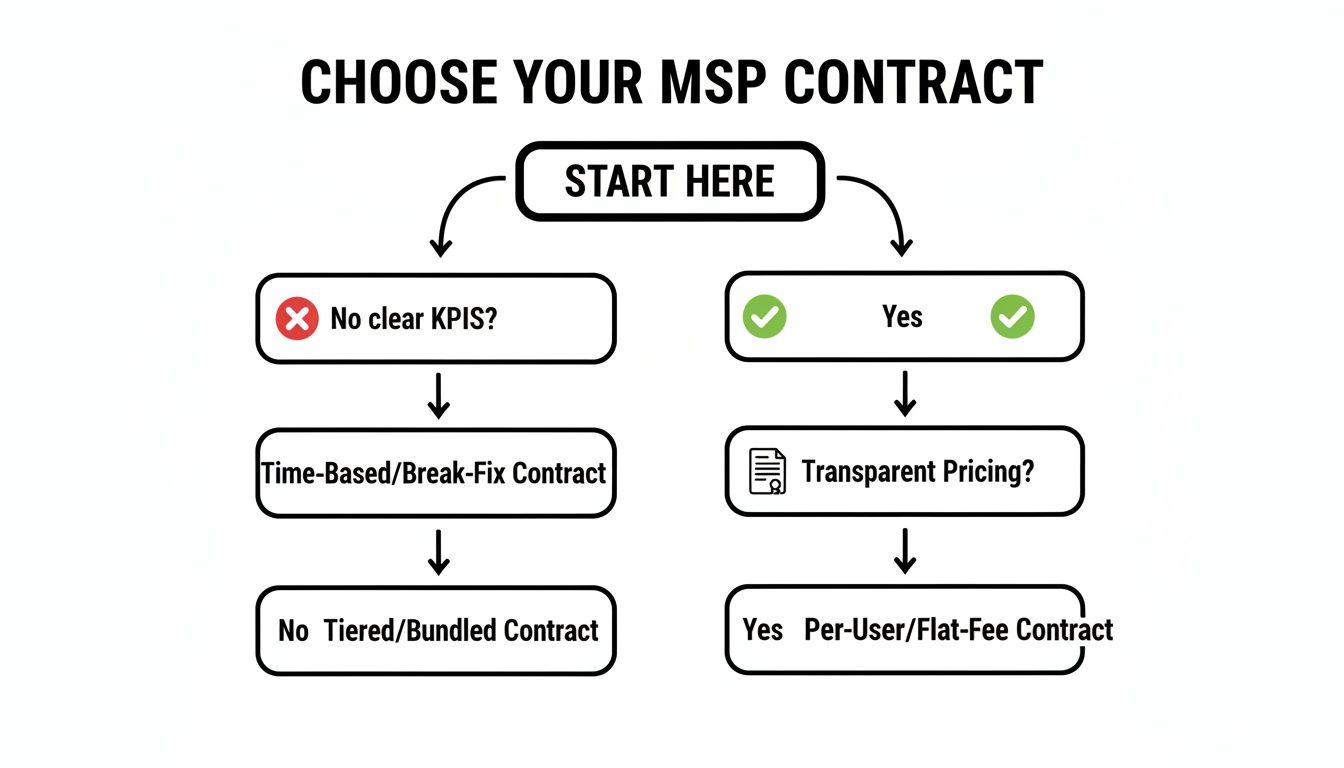
Without this clarity, the partnership is set up for failure. An effective scorecard ensures these factors are central to your decision.
Here's a straightforward template to score your finalists. Adjust the criteria and weighting to fit what matters most to your business—for example, HIPAA compliance is a dealbreaker for a medical clinic, while 24/7 production line support might be the top priority for a manufacturer.
MSP Vendor Comparison Scorecard
| Evaluation Criteria | MSP Candidate A Score (1-5) | MSP Candidate B Score (1-5) | Notes |
|---|---|---|---|
| Industry Expertise & Case Studies | |||
| Security & Compliance Controls | |||
| Technical Competency (Engineers) | |||
| SLA & Documented Response Times | |||
| Client References & Reputation | |||
| Cultural Fit & Communication Style | |||
| Pricing Transparency & Value | |||
| TOTAL SCORE |
By relying on a data-driven approach like this, you remove the guesswork. You can confidently select a managed service provider who is not just a vendor, but a strategic partner ready to help you grow.
Final Questions Before You Sign
As you get closer to a final decision, a few last-minute questions always pop up. Getting these details ironed out is the final step to feeling confident you're making the right choice for your business.
What’s the Biggest Mistake Businesses Make When Choosing an MSP?
The most common pitfall is focusing on the monthly price instead of the total value and risk reduction. A provider that looks cheaper on paper is often cutting corners—perhaps with offshore support, slow response times, or a lack of strategic expertise.
This "cheapest is best" mindset almost always backfires. You end up paying more in the long run through extended downtime, a devastating security breach, or inefficient operations. Always evaluate a potential partner based on their security model, documented compliance knowledge, and alignment with your business goals.
How Long Should an MSP Contract Be?
Most MSP contracts run from one to three years. While a longer-term agreement might offer a better price, starting with a one-year contract is often the smartest move. It gives you enough time to evaluate the partnership without a lengthy commitment if things don't work out.
A key thing to look for is a 90-day out clause for non-performance. This gives you an escape hatch and keeps the provider accountable for delivering on what they promised.
Should I Go With a Local or National Provider?
This depends on your specific needs. A local MSP, like one focused on the New York Tri-State area, can offer a more personal relationship. They can get on-site faster when needed and often have a better grasp of regional business challenges and compliance rules like the NY SHIELD Act.
National providers might have a wider service catalog, but their support can feel impersonal and rigid. For businesses in regulated fields like healthcare or finance, a local provider who truly understands your vertical often feels less like a vendor and more like an extension of your own team.
Ready to partner with an MSP that puts your security, compliance, and growth first? The team at CitySource Solutions provides a security-first, all-inclusive IT partnership designed for regulated industries in the Tri-State area. Learn how we can transform your IT into a strategic asset.