
Managed IT services are more than an outsourced helpdesk; for manufacturers, they are a strategic partnership designed to synchronize technology directly with production goals. The objective is to transform your entire tech stack—from the front office to the factory floor—into a high-performance engine that drives your business forward, not a liability that holds it back.
Why Manufacturers Need Specialized IT Partnerships
In a high-stakes manufacturing environment, generic IT support is a liability. Your factory isn’t a typical office. Its technology powers your entire operation, and you can't trust a general mechanic to optimize a Formula 1 car. A standard IT provider lacks the specialized knowledge to manage the complex interplay between your operational technology (OT) on the factory floor and the back-office IT systems.
This is where a managed services provider (MSP) specializing in manufacturing makes a measurable difference. View them as your dedicated pit crew, tasked with proactive maintenance, security, and optimization to prevent costly breakdowns before they happen. They understand the unique challenges you face daily.
The Modern Manufacturing Battlefield
Today's manufacturers are under immense pressure. The landscape is riddled with constant threats that can bring production to a halt without warning, making a forward-thinking technology strategy a requirement for survival.
To stay competitive, you must address these key challenges head-on:
- Persistent Cyber Threats: Actively defend your operational technology (OT) and Industrial Control Systems (ICS). Sophisticated attacks now specifically target these systems to disrupt physical processes and shut down your lines.
- Supply Chain Volatility: Implement agile, resilient systems that can adapt on the fly to sudden changes in lead times and supplier availability.
- Unrelenting Pressure for Uptime: Treat reliability as a non-negotiable requirement. Every minute of unplanned downtime translates directly into lost revenue, so your IT strategy must be built around maximizing operational availability.
Actionable Insight: Implement a proactive, security-first IT strategy as the foundation of a resilient operation. This ensures your technology works for you, not against you, by preventing issues instead of just reacting to them.
Partnering with the right MSP delivers tangible results. As more organizations adopt this model, they are finding they can reduce IT costs by 20-30% while boosting productivity. More importantly for manufacturers, a specialized provider can slash the risk of cyberattacks by up to 50%—a crucial defense in today's threat-heavy world. This partnership transforms your technology from a reactive cost center into a strategic driver of efficiency. You can also learn more about why local IT partnerships are key for security in regulated sectors.
Comparing In-House IT vs Managed IT Services for Manufacturing
Choosing between an in-house IT team and a specialized MSP is a critical strategic decision. It's not just about cost; it's about capability, security, and future-proofing your operations. This table breaks down common manufacturing challenges and provides an actionable comparison of how each approach handles them.
| Challenge | In-House IT Approach | Managed IT Services Approach |
|---|---|---|
| OT & IIoT Security | Often lacks specialized OT security tools and expertise. Focus is primarily on corporate IT. | Deploys managed EDR, 24/7 SOC, and SIEM with OT-specific threat intelligence. |
| 24/7 Uptime | Support is limited to business hours. Staff burnout is common when dealing with after-hours emergencies. | Provides 24/7/365 monitoring and support from a dedicated team, ensuring rapid response to any issue. |
| Specialized Skills | Team may be skilled in general IT but lack deep knowledge of SCADA, PLC, or MES systems. | Access to a bench of certified experts in industrial networking, cloud, and cybersecurity. |
| Cost Management | High, fixed overhead (salaries, benefits, training). Capital expenditures for new tools are significant. | Predictable, flat-rate monthly fee (OpEx). Access to enterprise-grade tools without the upfront cost. |
| Compliance & Audits | Burden falls entirely on a small internal team, often leading to gaps in documentation and controls. | Experienced in navigating CMMC, NIST, and other regulations. Manages documentation and provides audit support. |
| Strategic Planning | Overwhelmed with daily tickets and "firefighting," leaving little time for long-term strategy. | Acts as a strategic partner (vCIO) to align technology roadmaps with production and business goals. |
While an in-house team offers familiarity, most manufacturers cannot match the breadth of expertise, advanced security stack, and around-the-clock coverage that a specialized MSP provides. Partnering with an MSP shifts your focus from reactive problem-solving to proactive, strategic growth.
Securing the Factory Floor by Bridging IT and OT
On a modern manufacturing floor, two technology worlds collide: Information Technology (IT), which runs data and business apps, and Operational Technology (OT), the specialized gear that physically controls machines and monitors production lines.
Traditionally, these worlds were kept separate. IT was protected by firewalls, while OT was "air-gapped"—disconnected from outside networks. Today, the Industrial Internet of Things (IIoT) has bridged that gap. This connection creates huge opportunities for efficiency but also opens a dangerous new front for cyber threats. A standard IT security playbook is ineffective here; an antivirus scan could crash a sensitive PLC. This convergence demands a security strategy built for the unique realities of a connected factory.
This is where managed IT services designed for manufacturing come in, focusing on the core pillars of uptime, security, and proactive support.
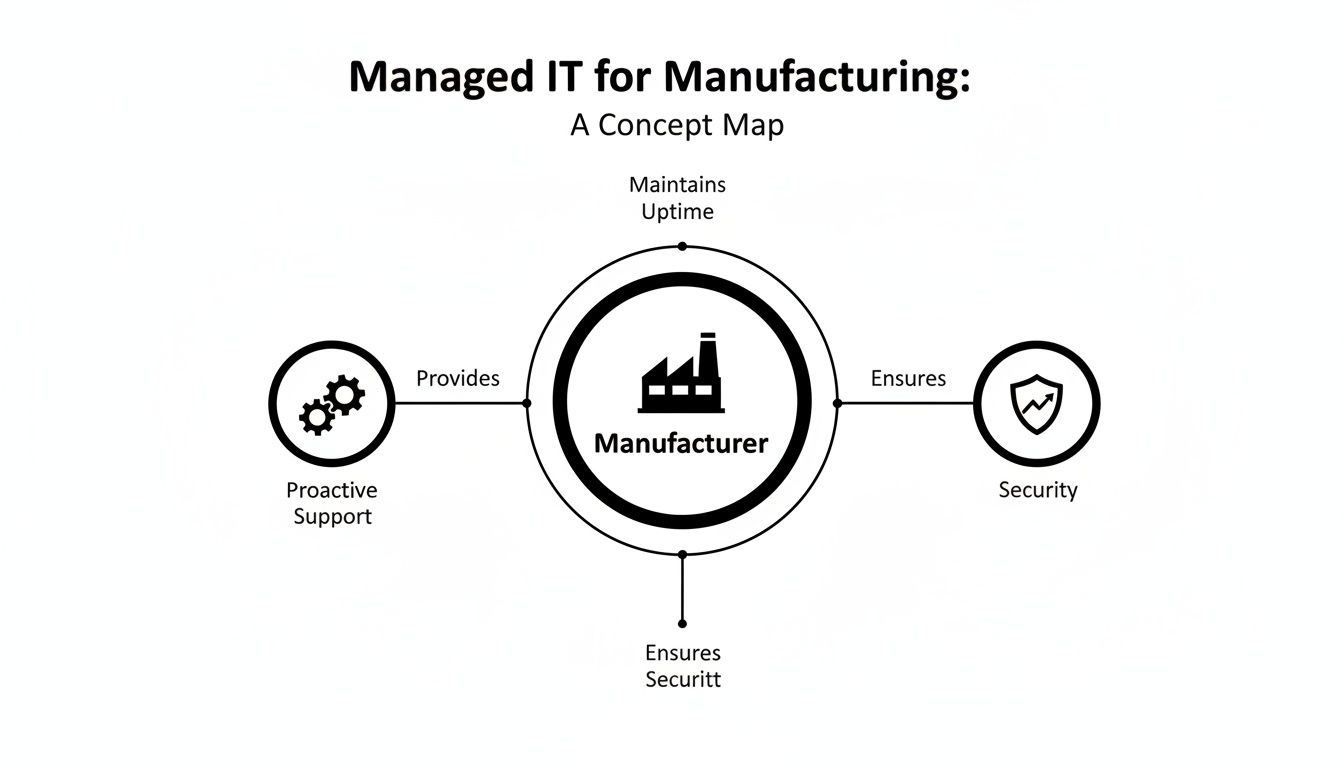
These elements are not separate goals but interconnected parts of a single strategy to protect and optimize your entire production environment.
Understanding the OT Security Gap
The primary goal of IT security is protecting data. For OT, the top priority is availability and safety—ensuring physical processes run without interruption or risk. A data breach in the front office is a massive problem, but an OT breach that shuts down a production line is a catastrophic event for both revenue and employee safety.
Threats to OT are unique. A compromised IIoT temperature sensor could feed false data, ruining entire batches. A ransomware attack that slips past corporate defenses and enters the OT network could disable machinery, halting production for days.
Actionable Insight: Prioritize securing the bridge between IT and OT. This is your single most important defense against costly downtime and operational failure. A digital threat that causes a physical disruption poses the greatest risk to your factory.
This is why managed IT services for manufacturers must be laser-focused on OT-aware security that respects the realities of the factory floor.
Actionable Strategies for Industrial Cybersecurity
Protecting a connected manufacturing environment requires a multi-layered defense. It starts with visibility—knowing what's on your network—and extends to actively hunting and responding to threats. A specialized managed services provider will implement these key strategies.
- Network Segmentation: Implement digital firewalls between your IT and OT networks. By creating separate zones, you contain threats. If malware infects an office computer, segmentation stops it from jumping to critical machinery on the factory floor.
- Industrial Endpoint Detection and Response (EDR): Deploy EDR designed for OT environments like Human-Machine Interfaces (HMIs). It monitors for unusual behavior without disrupting sensitive industrial processes.
- 24/7 Security Operations Center (SOC): Engage a 24/7 SOC for around-the-clock monitoring of both IT and OT networks. This provides a combination of advanced tools and human experts to spot and neutralize threats in real time. For more on this, learn SOC monitoring can reduce cyber risk in real-time.
From Theory to Practice: A Real-World Scenario
Imagine an automotive parts manufacturer. An employee clicks a phishing link, and ransomware infects their computer. Without proper segmentation, the malware crawls across the network. It finds a path to the OT network and hits the SCADA system server. Within minutes, assembly line robots freeze, and production is dead in the water.
Now, let's replay that with a proactive managed security service in place. The industrial EDR solution spots the ransomware's abnormal behavior as it tries to cross into the OT network. An alert is instantly sent to the 24/7 SOC. An analyst investigates, isolates the infected machine, and neutralizes the threat within minutes—long before it touches production. The factory keeps running.
Driving Operational Excellence with Proactive IT
In manufacturing, success isn't just about preventing disasters; it's about actively squeezing more efficiency out of your operations. Proactive managed IT services for manufacturers stop being a defensive cost and become an offensive tool to directly boost production outcomes by identifying trouble before it leads to costly unplanned downtime.
Think of your manufacturing line as a Formula 1 car. An expert pit crew constantly monitors engine data and optimizes performance in real time. A specialized MSP acts as that dedicated pit crew for your technology, ensuring every component runs at peak performance.
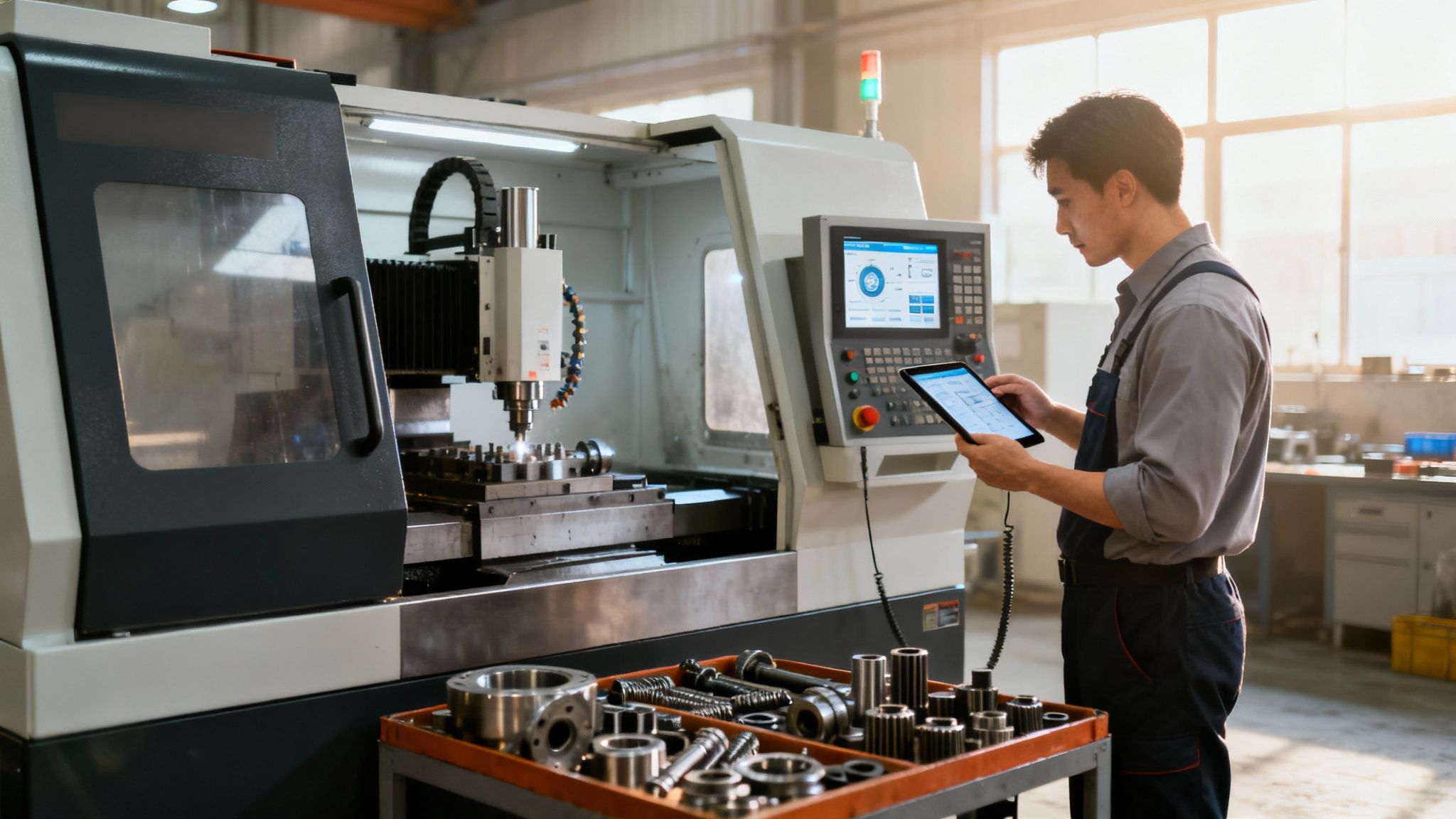
This proactive stance turns IT from a reactive expense into a powerful engine for operational excellence.
From Reactive Fixes to Predictive Maintenance
The old "break-fix" IT model is a recipe for disaster on the factory floor. When a critical server goes down, every second spent troubleshooting is lost revenue. Unplanned downtime costs manufacturers an estimated $50 billion annually.
Proactive IT flips that script. By using advanced monitoring tools, an MSP can spot the subtle warning signs of impending failure. Implement these key actions:
- Constant Health Monitoring: Use specialized tools to watch the performance of servers, network gear, and industrial controllers, looking for anomalies.
- Predictive Analytics: Analyze performance trends over time to predict when a component is likely to fail. Schedule maintenance during planned downtime, not in the middle of a critical production run.
- Automated Patching and Updates: Keep systems secure and up-to-date automatically to close security holes before they can be exploited, without interrupting operations.
Moving from reactive to predictive has a direct, measurable impact on your bottom line by maximizing uptime and asset lifespan.
Integrating Systems for Seamless Data Flow
A modern factory runs on data. Information from SCADA systems, PLCs, and shop-floor sensors must flow seamlessly into your ERP software. This integration is the backbone of inventory management and production scheduling.
When these systems are siloed, the result is inefficiency and poor decision-making. A key role for a manufacturing-focused MSP is to build secure and reliable bridges between these technologies.
Actionable Insight: Ensure data from the shop floor instantly informs decisions on the top floor. A unified data flow creates a single source of truth, giving managers the real-time insights needed to cut waste, improve quality control, and ensure on-time delivery.
For example, connecting a PLC’s output data directly to your ERP can automate inventory adjustments and trigger raw material reorders exactly when needed, eliminating guesswork. This integration turns complex data streams into actionable business intelligence that drives tangible results.
Building a Future-Ready Factory with Cloud and AI
To stay competitive, you must build a factory that's ready for tomorrow by weaving advanced technologies like cloud computing, AI, and machine learning (ML) into your production environment. A skilled managed services partner can help you implement these powerful tools.
Think of the cloud as an infinitely scalable foundation. Instead of being limited by aging on-premise servers, cloud platforms like Microsoft Azure provide the computing power to handle massive data streams from your machines. A provider specializing in managed IT services for manufacturers with deep cloud migration experience makes this transition seamless and secure.
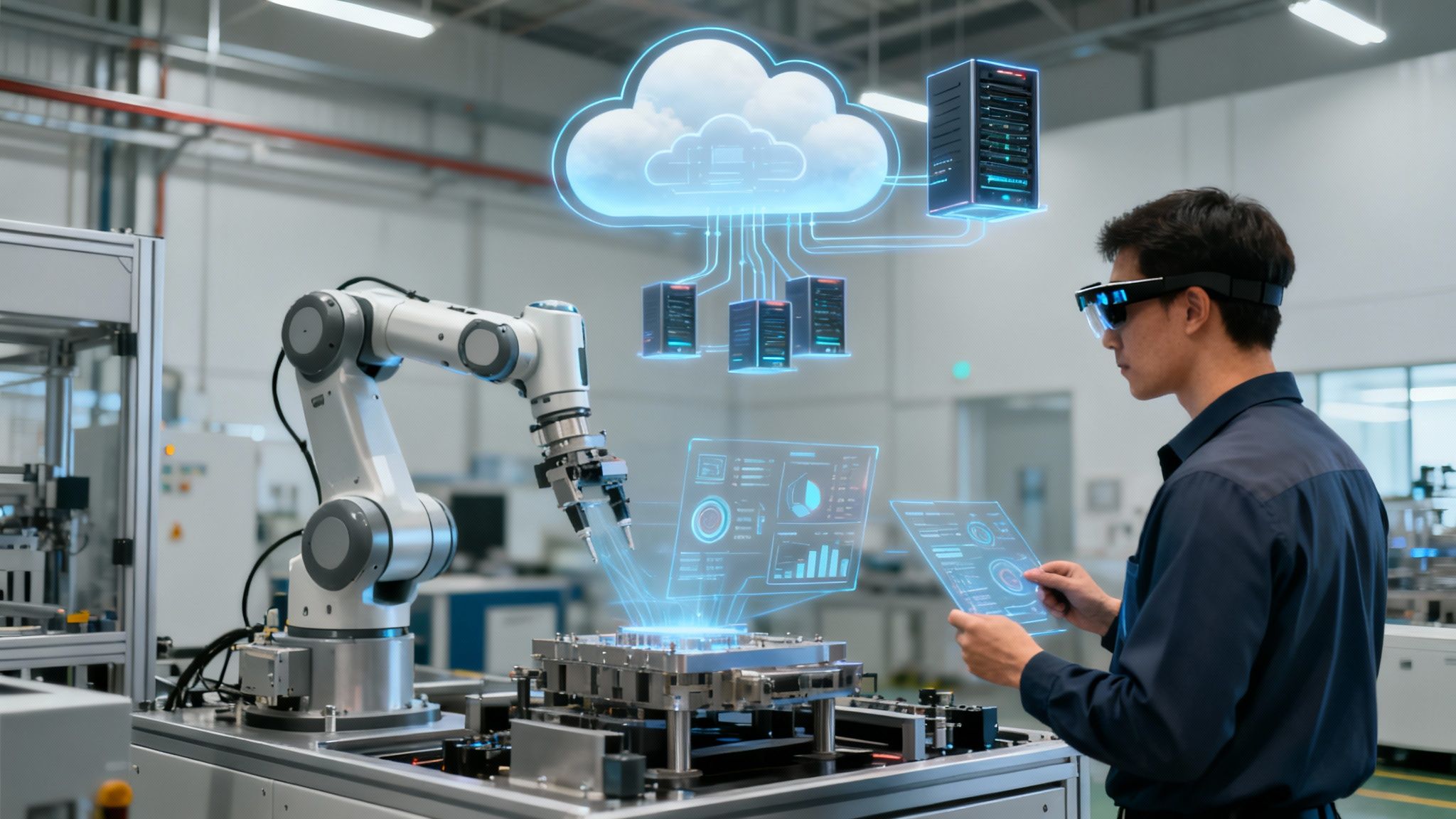
Unlocking Data with Cloud and AI Integration
Once your data is centralized in the cloud, you can put it to work with AI and ML. An MSP acts as the architect, ensuring data flows securely from the factory floor to the cloud for analysis.
This integration unlocks game-changing capabilities:
- AI-Driven Predictive Analytics: Use AI algorithms to analyze real-time equipment data and predict breakdowns with high accuracy. This allows you to schedule maintenance precisely when needed, slashing downtime.
- Machine Learning for Quality Control: Implement ML models that analyze images or sensor readings to spot microscopic defects a human inspector might miss, driving up product quality and reducing waste.
- Remote Monitoring and Scalable Operations: With systems in the cloud, your team and MSP can securely monitor operations from anywhere. You can also scale computing resources on demand, paying only for what you use.
Actionable Insight: Partner with an MSP to integrate AI and ML. This transforms your factory’s data from a simple record of past events into a predictive engine that shows you what will happen next.
Creating a Smart Manufacturing Roadmap
The shift to a smart factory is a journey. A recent Deloitte survey found that 80% of manufacturing executives plan to invest 20% or more of their improvement budgets in smart factory initiatives. As connected IIoT devices multiply, managed services become essential for orchestrating these complex networks. For more on this, check out the trends shaping managed services in 2025.
A qualified MSP will work with you to build a practical, phased roadmap. This journey typically starts with a cloud migration to build the right foundation. Our guide on building a cloud migration end-to-end strategy is a great starting point. From there, they help you pinpoint the highest-impact use cases for AI and ML in your specific operation. This strategic partnership ensures your technology investments are directly tied to business outcomes.
How to Choose the Right Manufacturing IT Partner
Picking a managed services provider is a critical technology decision. Get it right, and you gain a partner who becomes an extension of your team, driving uptime and security. Get it wrong, and you face production disruptions and costly vulnerabilities.
Your goal is to find a team that speaks the language of manufacturing—one that understands the fundamental difference between office IT and factory floor OT. They must appreciate that a delayed response can mean a production line grinding to a halt.
Look for Proven Manufacturing Experience
First, filter for providers with a deep, verifiable track record in the manufacturing sector. A generalist MSP supporting dental offices won't have the background to secure a complex industrial environment.
Here’s what to look for to verify manufacturing expertise:
- OT and IIoT Fluency: They must discuss SCADA, PLCs, and IIoT devices confidently and provide concrete examples of how they've secured these systems.
- Compliance Knowledge: The provider must understand your regulatory world, whether it's CMMC for defense contracts, NIST standards, or other industry-specific rules.
- Relevant Case Studies: Ask them to share success stories from manufacturers similar to yours as proof that they've solved the problems you face.
Vet Their Security Operations and Tools
Cybersecurity is a massive piece of this puzzle. Research shows that for 60% of businesses, security is their single biggest challenge. And for manufacturers, a staggering 78% see MSPs as essential partners for managing their IoT devices. Dig into more of these key MSP statistics and trends to see the full picture.
A security-first MSP won't just protect your corporate network; they'll build a layered defense that extends right onto your factory floor.
Actionable Insight: Verify that any potential partner has a non-negotiable, 24/7 security posture. In manufacturing, a threat doesn't wait for business hours, and your defense can't either.
Insist on these non-negotiable security components:
- 24/7 Security Operations Center (SOC): Demand a dedicated, around-the-clock team of security analysts watching for threats.
- Managed Endpoint Detection and Response (EDR): The provider must deploy and manage EDR tools that are compatible with your industrial systems.
- Managed SIEM: A Security Information and Event Management (SIEM) platform is crucial for pulling security data from your entire environment—IT and OT—to spot hidden threats.
Insist on Ironclad Service Level Agreements
A Service Level Agreement (SLA) is your performance guarantee. For any manufacturer, SLAs must be laser-focused on metrics that directly impact production, especially uptime and response time. A vague SLA is a major red flag.
Your SLA must clearly define:
- Guaranteed Uptime: What percentage of uptime do they guarantee for critical systems? This number should be 99.9% or higher for essential infrastructure.
- Response and Resolution Times: How quickly will they respond to an alert, and what is the target time to fix it? These times must be broken down by severity level.
- Penalties for Non-Compliance: What happens if the provider fails to meet the SLA? There should be clear financial penalties or service credits.
This agreement holds your partner accountable. An MSP that confidently signs a strict, manufacturing-focused SLA is one that knows they can deliver.
Essential Questions to Ask a Potential Manufacturing MSP
Use this checklist to separate the generalists from the true manufacturing specialists.
| Category | Key Question | Why It Matters for Manufacturers |
|---|---|---|
| Industry Experience | Can you provide three case studies from manufacturers in our specific sub-sector (e.g., aerospace, food processing)? | General manufacturing experience is good; specific, relevant experience is better. It proves they understand your unique operational challenges. |
| OT & IIoT Security | How do you approach segmenting our OT network from our IT network? What tools do you use to monitor OT assets? | This is the single most important technical question. A failure to answer this confidently indicates a lack of preparedness for industrial environments. |
| Security Operations | Is your Security Operations Center (SOC) in-house or outsourced? Do your analysts have experience with industrial control system (ICS) alerts? | An in-house, 24/7 SOC with OT experience ensures that alerts from your plant floor aren't misinterpreted or ignored by analysts trained only on corporate IT. |
| Service Level Agreements | Can your SLA guarantee specific uptime percentages for our SCADA systems and production-critical servers? | Vague uptime promises are useless. You need contractual guarantees tied directly to the systems that impact your revenue and output. |
| Compliance & Frameworks | How have you helped other manufacturers achieve or maintain compliance with frameworks like NIST 800-171 or CMMC? | This demonstrates they can do more than just "fix computers." They can be a strategic partner in meeting regulatory demands and winning contracts. |
| Incident Response | Walk me through your incident response plan for a ransomware attack that starts on an engineer's laptop and spreads to the plant floor. | Their answer will reveal their true understanding of how cyber-physical attacks unfold and whether their plan is realistic for an industrial setting. |
This isn't just about finding a vendor; it's about finding a partner who understands that in manufacturing, technology is the engine of your entire operation. Use these questions to ensure you find a team ready for that responsibility.
Your Roadmap to a Smooth IT Transition
Switching to a managed IT services provider can feel like a massive project, with the primary fear being operational disruption. However, a professional transition isn't a chaotic "rip and replace" event. It’s a carefully planned, phased process designed to ensure your production lines never miss a beat. The right partner works like a stealth ops team, implementing new systems behind the scenes long before the official cutover.
This methodical approach builds confidence and turns a potentially stressful change into a smooth, predictable upgrade.
A Phased and Transparent Onboarding Process
The journey starts with a deep dive into your current environment. A skilled provider doesn’t just show up and install software. They listen, learn, and understand your specific operational needs and production workflows before making a single change.
Here is a typical non-disruptive roadmap:
- Initial Discovery and Assessment: This first step is a thorough audit of your existing IT and OT infrastructure. Engineers map your network, identify security vulnerabilities, and document every critical system from your ERP down to the PLCs on the floor.
- Strategic Roadmap Development: Using the assessment findings, the MSP collaborates with your team to build a clear technology roadmap. This plan outlines immediate fixes and long-term goals, ensuring every IT initiative aligns with your core business objectives.
- Silent Tool Deployment: The MSP quietly deploys its monitoring and security tools in the background. Agents for Endpoint Detection and Response (EDR) and network monitoring are installed without interrupting users, allowing the team to gather baseline data before officially managing the network.
- Phased Service Migration: The final step is a series of carefully scheduled migrations. Services like helpdesk support, server management, and security monitoring are transitioned one by one for a controlled and seamless handover.
A Case Study in Seamless Transition
Imagine a metal fabricator, "Precision Parts Inc.," running on aging servers and dealing with network slowdowns affecting their CNC machines. They partnered with a manufacturing-focused MSP to modernize their infrastructure.
Actionable Insight: A successful IT transition isn't about flipping a switch overnight. The goal is to build a new, stronger foundation piece by piece, ensuring the business operates without interruption while the underlying technology is transformed.
The MSP started by installing monitoring agents after hours, immediately identifying a failing network switch causing the bottlenecks. They scheduled its replacement during a planned weekend maintenance window, avoiding any downtime.
In the weeks leading up to the full transition, they migrated the company’s data to Microsoft 365 and Azure, moving one department at a time.
On the official "go-live" day, employees at Precision Parts Inc. barely noticed a change—except that their systems were suddenly faster and more reliable. Production was never halted, and the factory’s technology was quietly modernized without a single moment of costly downtime.
Answering Your Questions About Managed IT Services in Manufacturing
Switching to a managed services partner is a big move. It’s normal to have practical questions about how it impacts your budget, your people, and your shop floor. Here are direct answers to the most common questions we hear.
Our goal is to cut through the noise and give you a clear, actionable picture of what a partnership with a manufacturing-focused IT provider really looks like.
Will Managed Services Replace My Existing IT Staff?
No. The goal of a managed IT services partner is to supercharge your internal team, not replace them. This co-managed IT model is built for partnership.
Your provider handles the grueling 24/7 work—security monitoring, patching, and network management. This frees up your on-site IT experts to focus on high-value projects that drive the business forward. Instead of firefighting, they can:
- Optimize your ERP system to improve production efficiency.
- Collaborate with engineers to roll out new IIoT sensors or robotics.
- Build custom dashboards for better visibility into shop-floor data.
This approach gives your key players an elite support crew, allowing them to focus on innovation instead of maintenance.
How Is The Cost Justified Against The Budget?
Managed IT services shift your spending from unpredictable capital expenses (CapEx) to a flat-rate operating expense (OpEx). Instead of a massive, unplanned bill for a dead server or a cyberattack, you pay a consistent monthly fee that covers everything from daily support to enterprise-grade security tools.
The real return on investment (ROI) comes from prevention:
- Dramatically Reduced Downtime: Proactive monitoring catches problems before they can shut down a production line, directly preventing lost revenue.
- Improved Cybersecurity: The cost of preventing a single ransomware attack can justify several years of managed service fees.
- Increased Productivity: Your team stops wasting time on IT glitches and gets back to their core responsibilities.
Actionable Insight: You are not just buying an IT service; you are investing in operational uptime and risk management. A good partnership pays for itself by preventing costly disasters and making your entire operation more efficient.
What Is The Typical Onboarding Timeline?
A seamless transition is paramount. A professional MSP uses a careful, phased approach to avoid any disruption. A typical onboarding process takes 30 to 90 days.
The process is methodical and transparent. It begins with a deep-dive discovery phase, followed by the silent deployment of monitoring tools. The actual handover of services occurs in stages, usually after hours or during planned maintenance windows, to ensure production is never affected.
Ready to turn your factory's technology from a constant headache into a true competitive advantage? The U.S.-based engineers at CitySource Solutions specialize in security-first managed IT services that guarantee uptime and protect your operations. Get in touch today to build your strategic IT roadmap.